












TL;DR
In 2025, teams that integrated user research into both product and business decisions saw 2.7X better outcomes, as research shifted from validation to a core driver of strategy.
In 2026, that role has expanded. Research is now essential to strategy and operations in 22% of organizations (up from 8% in 2025), 66% of teams report higher demand for research, and 69% use AI in at least some of their studies.
Across both years, the big story is the same. User research is more influential, more distributed across teams, and more AI-enabled, but the organizations that benefit most are the ones building systems (training, shared standards, repositories, and governance) that make research repeatable and reliable.
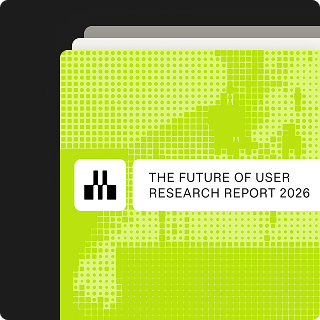
Check out the 2026 Future of Research Report to get up-to-date insights on the current state of user research.
User research is shaping product and business decisions faster than ever. As demand grows, teams need to scale insights, prove impact, and balance speed with rigor.
For the third year in a row, we’re publishing The Future of User Research Report, capturing the evolving role of research in driving smarter, faster, and more confident decision-making.
For the 2025 edition, we surveyed 800+ Research, Product, and Design professionals to uncover how teams are breaking silos, embedding research into strategy, and leveraging AI to amplify their work. Research is no longer just about validating ideas—it’s driving business outcomes, de-risking decisions, and fueling continuous innovation.
At Maze, we believe the companies that win are those that integrate user insights at every stage of product development—ensuring every decision is powered by real user needs. As we share this report with the Research and Product community, our goal is to highlight emerging trends, foster discussion, and help teams unlock the full potential of research.


The vision behind the Future of User Research Report
As research becomes more integrated into decision-making, challenges around efficiency, strategy, and proving research ROI continue to grow. Product teams face increasing pressure to move fast and scale insights—all while navigating new technologies and evolving customer expectations. Understanding where user research is headed is crucial to staying ahead. That’s the driving force behind The Future of User Research Report.
These annual reports exist to track the continued development of user research and how industry priorities are changing over time. By analyzing these trends year after year, we aim to provide organizations with data-driven insights that help them make informed decisions about their research strategies, tools, and methodologies.
But, beyond the numbers, this report is also about the people behind the research—the UX researchers and other PWDR who spend their time listening to users to ensure products meet real needs.
Here, we shine a light on them—capturing their experiences, challenges, and aspirations to give them a voice in shaping the future of the field. As Research continues to evolve, understanding these perspectives is essential to building better, more user-centered products.
Ultimately, the data and insights we gather through this report support our mission to help companies build the right products faster—making user insights available at the speed of product development.
Top 5 Takeaways from the Future of User Research Report
Here are the five key takeaways that will define the future of user research—shaping how teams make better, faster decisions in product development.
Let’s take a look.
1. The more research is integrated, the greater its business impact
Companies that apply user research across all operations see stronger business results. It’s not just about improving products—it’s about making better decisions at every level of product development and business strategy.
Teams that integrate user research into both product decisions and broader business strategies see 2.7X better outcomes—including higher revenue growth and improved customer retention—compared to those who rarely leverage user research.
When research is a core part of strategy, companies gain a competitive edge. Teams can adapt faster, build products that meet user needs, and stand out in the market. Conversely, teams who fail to prioritize research risk falling behind.
2026 Update: Is this still true?
In 2026, research is becoming a core driver of business strategy. The share of organizations where research is essential to all levels of business strategy and operations nearly tripled in a single year, rising from 8% in 2025 to 22% in 2026.
At the same time, 41% of organizations now use research to inform both product and strategic business decisions, while the share of teams reporting that research is rarely used in decision-making fell from 13% to just 6%.
Plus, the demand for research is rising fast. Nearly 66% of teams saw an increase in demand over the last 12 months, up from 55% the year before, yet did not match these investments with training, systems, and infrastructure.
In 2026, integrated research still drives business impact, but only when it’s supported by the right foundations to prevent noise and protect credibility.
2. User research is a team effort
User research isn’t just for dedicated Research teams anymore. Designers (70%), product managers (42%), and marketers (18%) are taking a more active role in gathering insights. This shift means research is becoming a company-wide effort rather than a specialized function.
More people across the organization are compelled to conduct their own research—which is a good thing. This aligns with general trends for more user-centered approaches to drive business outcomes.
UX Research, Executive
Companies investing in dedicated support from UX researchers and access to user research tools are seeing stronger, research-backed strategies that drive better business outcomes. This expansion ensures that user insights are embedded earlier and more effectively into product development.
2026 Update: Is this still true?
Yes, research is even more of a team sport in 2026. Product managers (39%), market researchers (35%), and marketers (23%) are all running studies alongside dedicated research teams, confirming that user research is firmly a company-wide effort.
What’s changed is the risk. While 61% of organizations now provide access to research tools and templates for non‑researchers, fewer than half offer:
- Structured training (46%)
- Research libraries (49%)
- Dedicated support from specialized researchers (45%)
- Any support at all (13%)
This can lead to conflicting findings, duplicated work, and decisions made on unreliable data, making enablement and systems just as important as participation in user research.
3. The demand for research continues to grow
The digital landscape is becoming crowded, making it harder for products to stand out. User research helps identify unique user needs and pain points, providing a competitive edge.
Designer, Individual Contributor
User research keeps gaining traction as companies recognize its role in shaping better products and business strategies. In the 2024 Future of User Research Report, 62% of respondents reported an increase in demand. This year, 55% say that demand is still on the rise.
The shift toward user-centered decision-making continues to gain momentum. Respondents highlighted a few key factors driving this trend:
- The strategic importance of data-driven decisions. Executive buy-in has strengthened, with more teams seeking insights to make data-driven decisions.
- The race to ship the right products faster. With tighter timelines and rising customer expectations, research helps teams make informed choices early—reducing costly missteps.
- The need to stand out in a competitive market. Companies are relying on user research to innovate and uncover unique customer insights that drive differentiation and long-term success.
Want to learn more about the report's findings?
Watch our on-demand webinar where we break down the biggest takeaways and what they mean for the future of user research. Watch now.
2026 Update: Is this still true?
Demand for user research is still rising in 2026, with 66% of respondents reporting an increase over the last 12 months. More teams now depend on research to guide important product and business decisions.
This growing demand is driven by faster product cycles, greater competition, and higher expectations from leadership. Organizations need reliable insights to avoid costly mistakes and to stand out in crowded markets.
4. Time is the biggest challenge for teams
Product and research teams continue to face time and bandwidth constraints, with 63% of respondents citing this as their biggest challenge. As demand grows, teams are stretched thin—pushing researchers to move quickly while still delivering quality insights.
For enterprise companies, the challenge is even greater. 70% of big tech & software firms report time and bandwidth constraints, emphasizing the need for streamlined research workflows and scalable solutions to match the speed of product development.
2026 Update: Is this still true?
In 2026, researchers are being asked to support more teams and decisions. Demand is increasing, and teams are turning to AI to help overcome blockers—like time and bandwidth constraints. Amongst others, AI is being used to support with:
- Analyzing research data (76%)
- Transcription (57%)
- Planning and drafting research studies (56%)
- Generating research questions (55%)
- Synthesis and reporting (47%)
AI is empowering teams to meet the growing demand for more research, helping stakeholders across the organization overcome traditional barriers they’ve previously faced.
5. AI unlocks efficiency in product development and research
In our 2025 report, 58% of product professionals say they use AI in their workflows, up from 44% in 2024—reflecting a growing shift toward AI-driven efficiency in analyzing user research data, generating transcriptions, and crafting research questions.
For many teams, AI has become an essential tool in streamlining research and accelerating decision-making. While 58% cite improved efficiency and 57% report faster research cycles, teams remain cautious about full automation, relying on human-in-the-loop safeguards to ensure AI-generated insights stay accurate and meaningful.
AI can become an important tool in increasing and augmenting human capacity. It’s helpful as a decision-making tool, with the ability to assist in planning or to analyze large amounts of data. If we push for ethical behavior and appropriate safeguards, it’ll be like the switch from using paper to using computers.


Geordie Graham
Senior Manager, User Research at Simplii Financial
2026 Update: Is this still true?
In 2026, this trend holds true. Nearly 69% of respondents use AI in at least some of their research projects, such as transcription, synthesis, and drafting questions.
As a result, teams report faster research turnaround (63%), better team efficiency (60%), and more optimized workflows (56%).
At the same time, researchers still see AI as support, not a replacement. Human judgment remains essential for interpreting nuance, making ethical decisions, and final recommendations.
Build fast and right with Maze
The 2025 Future of User Research Report clearly shows that companies prioritizing user research outperform those that don’t. Product teams are moving beyond the outdated tradeoff between speed and insights, recognizing that the best products aren’t just the first to market—they’re the first to meet user needs. Rapid iterations without accurate insights lead to wasted resources, rework, and products that miss the mark.
At Maze, we believe time to right is the real competitive advantage—ensuring that user feedback drives every decision and iteration.
AI, advanced research tools, and a growing culture of research democratization make this possible, allowing teams to iterate with confidence, validate decisions in real-time, and move forward without guesswork.
The future belongs to teams that prioritize learning as they build. In today’s market, it’s not just about how fast you launch—it’s about what you launch that matters.