














TL;DR
Maze surveyed nearly 500 researchers, designers, and product professionals for the 2026 Future of User Research Report to understand where user research stands today, how it’s changing, and what’s on the horizon.
The report reveals:
- AI is now an established part of research, so human judgment is where teams add real value
- Research has more say in big, strategic decisions, not just features and usability
- Demand is rising, and more non‑researchers are running studies, while systems and enablement haven’t kept up, leading to bottlenecks and inconsistent data quality
- Teams need stronger systems, methods, and workflows to keep research credible, scalable, and connected to real user needs
Considered together, these shifts show that user research has matured and is now being stress‑tested by speed, scale, and spread.
When research demand jumps 20% year over year, but your headcount, tools, and processes stay the same, you get bottlenecks, burnout, and insights that struggle to keep up with the pace of decisions.
That’s the core tension at the heart of our 2026 Future of User Research Report.
AI is now embedded in research workflows, and more non-researchers are running studies. This means insights are being produced in more places than ever before, such as by product managers (39%), market researchers (35%), and marketers (23%).
At the same time, research is increasingly playing a key role in high‑stakes decisions and long‑term strategy, but the systems and standards that support it aren’t keeping pace, creating gaps in quality, consistency, and trust faster.
That combination of rapid development and uneven foundations is exactly where our story starts: capability and authority are rising, but the systems that support research are struggling to keep pace.
With insights from nearly 500 researchers, designers, and product professionals—including experts from Twilio, 1Password, Adobe, Mozilla, and more—the Future of User Research Report 2026 shows where practices are evolving and what needs to change next to make research reliable at scale.


The vision behind the Future of User Research Report
Our 2025 Future of User Research Report showed how integrating user research and UX research into product development and business strategy turns user insights into real business impact. This year’s report looks at what it takes for those embedded practices to stay credible as demand, democratization, and AI all accelerate at once.
In 2026, the focus moves to the future of user research, a world where research is embedded across product teams, UX design workflows, and strategic decision-making—and where AI tools and automation are becoming part of everyday research practices.
The Future of User Research Report 2026 highlights some key trends:
- AI has become a baseline part of research workflows, taking on more of the execution work and making human judgment the edge in interpreting nuance and shaping recommendations
- Research is reaching the boardroom, informing higher‑stakes decisions and long‑term strategy
- Demand for research keeps rising, and more non‑researchers are running studies, while systems, standards, and enablement lag behind, creating bottlenecks and inconsistent data quality
- Teams need stronger foundations with clear standards for AI, intentional human review, better enablement, and centralized insights, to keep research credible, scalable, and aligned with real user needs
3 Key takeaways from the 2026 Future of User Research Report
The 2026 Future of User Research Report pinpoints three shifts that define where user research is heading next:
- AI is baseline; human judgment becomes the edge
- Research influence is reaching the boardroom
- Pressure is building as research demand outpaces enablement
Let’s look at each of these in detail.
1. AI is baseline, human judgment becomes the edge
In 2026, research-grade AI is embedded in how research teams conduct user research and UX research, support product development, and run their day-to-day workflows.
The most immediate application for AI has been replacing the repetitive parts of research execution. But we’ve always known that just executing research has never been enough to be a successful researcher.


Dalia El‑Shimy
Director of User Research at Wise
Share
Here’s what that looks like in practice:
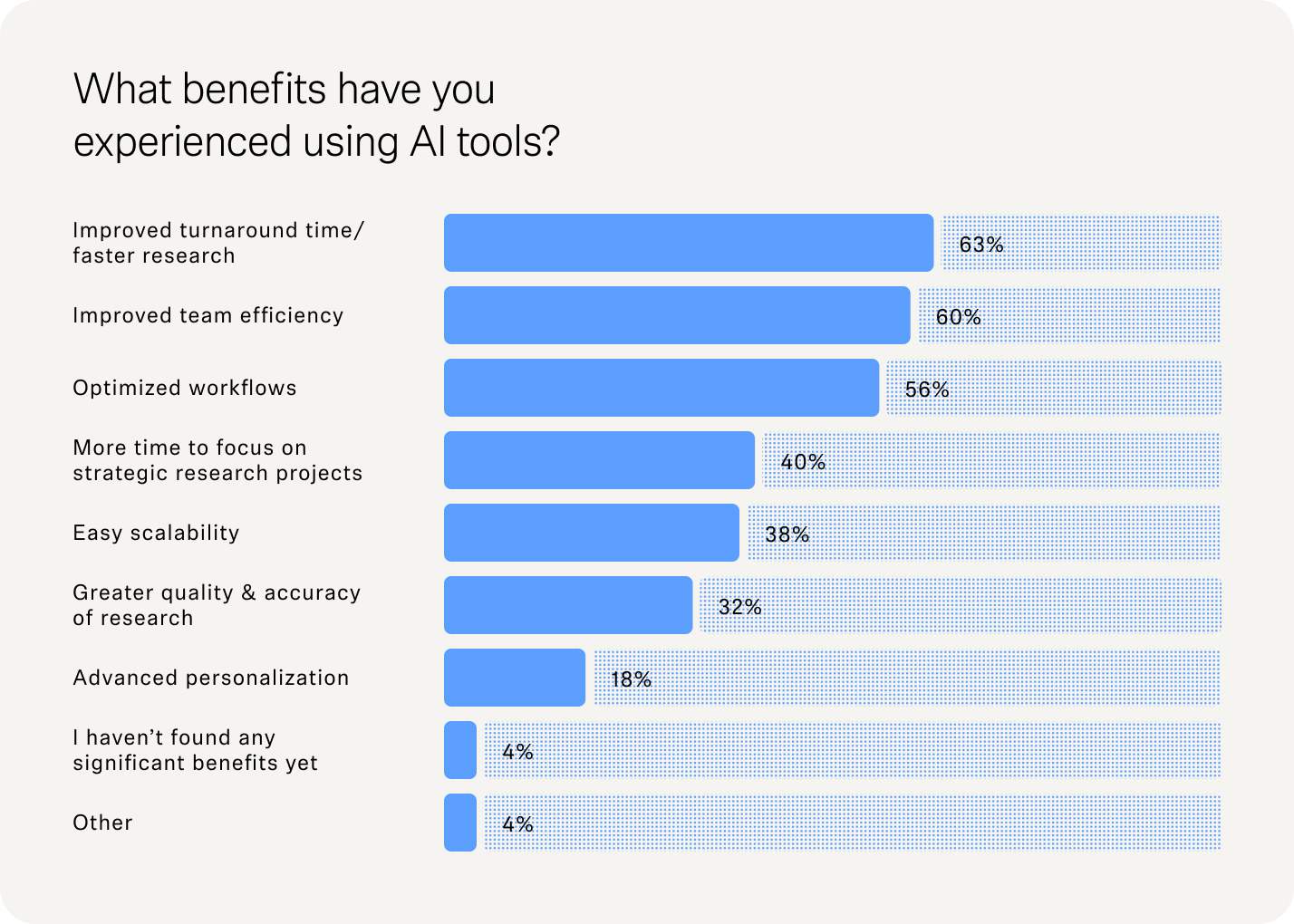
- Adoption: 69% of respondents use artificial intelligence in at least some of their research projects, a 19% increase from last year
- Where teams use AI tools: Product teams apply AI to core research methods like user interviews and surveys, using it for transcription, synthesis, and generating research questions
As a result, teams report faster turnaround times for research projects (63%), improved team efficiency (60%), and more optimized workflows (56%).

Human review is not a bottleneck; it’s a necessary part of the process for user researchers to make knowledgeable recommendations.


Daniel Soranzo
Principal UX Researcher at GoodRx
Share
AI is taking over more of the execution work, which frees up researchers to focus on the parts of the process that still need human judgment.
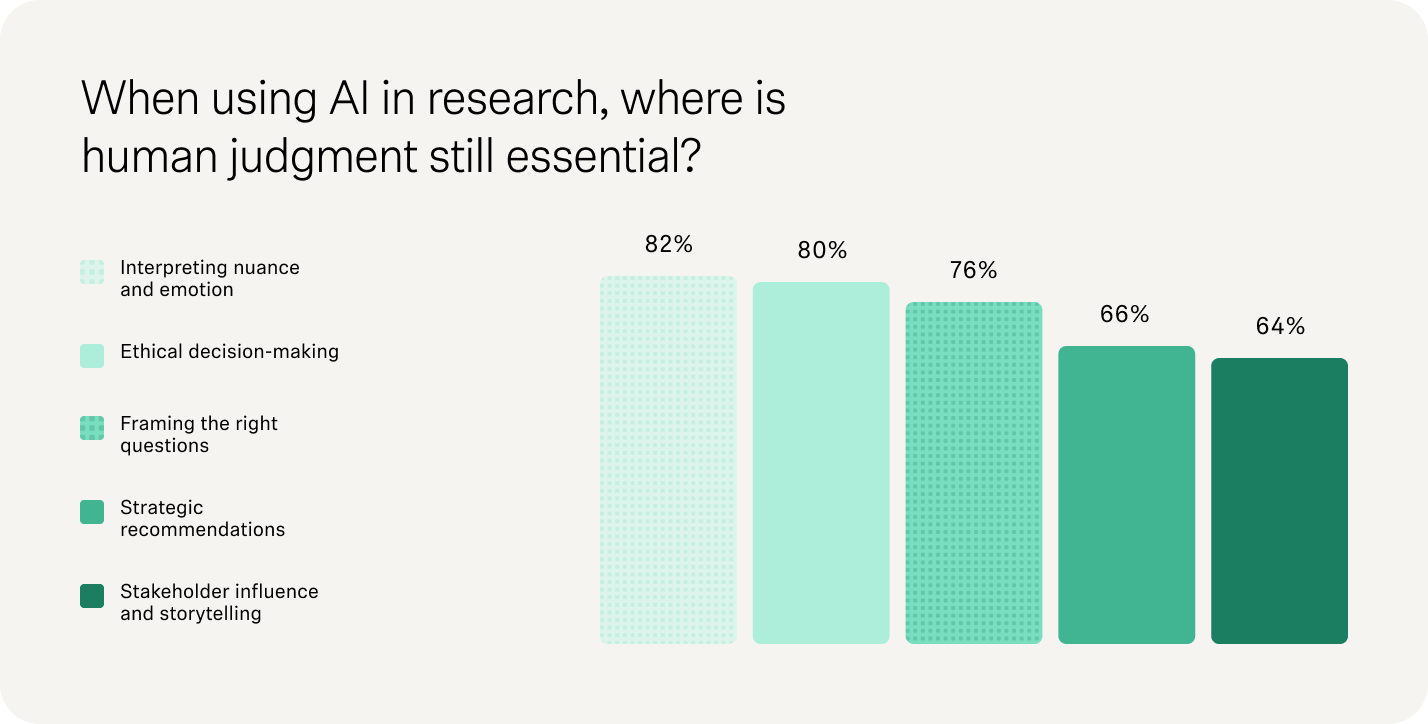
So, where do humans matter most in research?
- Interpreting nuance and emotion (82%)
- Ethical decision-making (80%)
- Framing the right research questions (76%)
- Making strategic recommendations for product development and business strategy (66%)
- Influencing stakeholders through storytelling (64%)

Human review is most valuable in the messy middle. Where you’re connecting what customers said… to what the organization should do about it.


Amanda Gelb
Strategic Researcher at Aha Studio Inc
Share
AI can summarize user interviews and highlight patterns, but it can’t read between the lines of human sentiment, balance different priorities for product managers and product designers, or decide which user insights matter most for real users and long-term business outcomes.
That’s why, in this first point, we treat AI as a new baseline for execution, while positioning human judgment—especially in that messy middle between raw data and decisions—as the real differentiator for teams.
2. Research influence reaches boardroom level

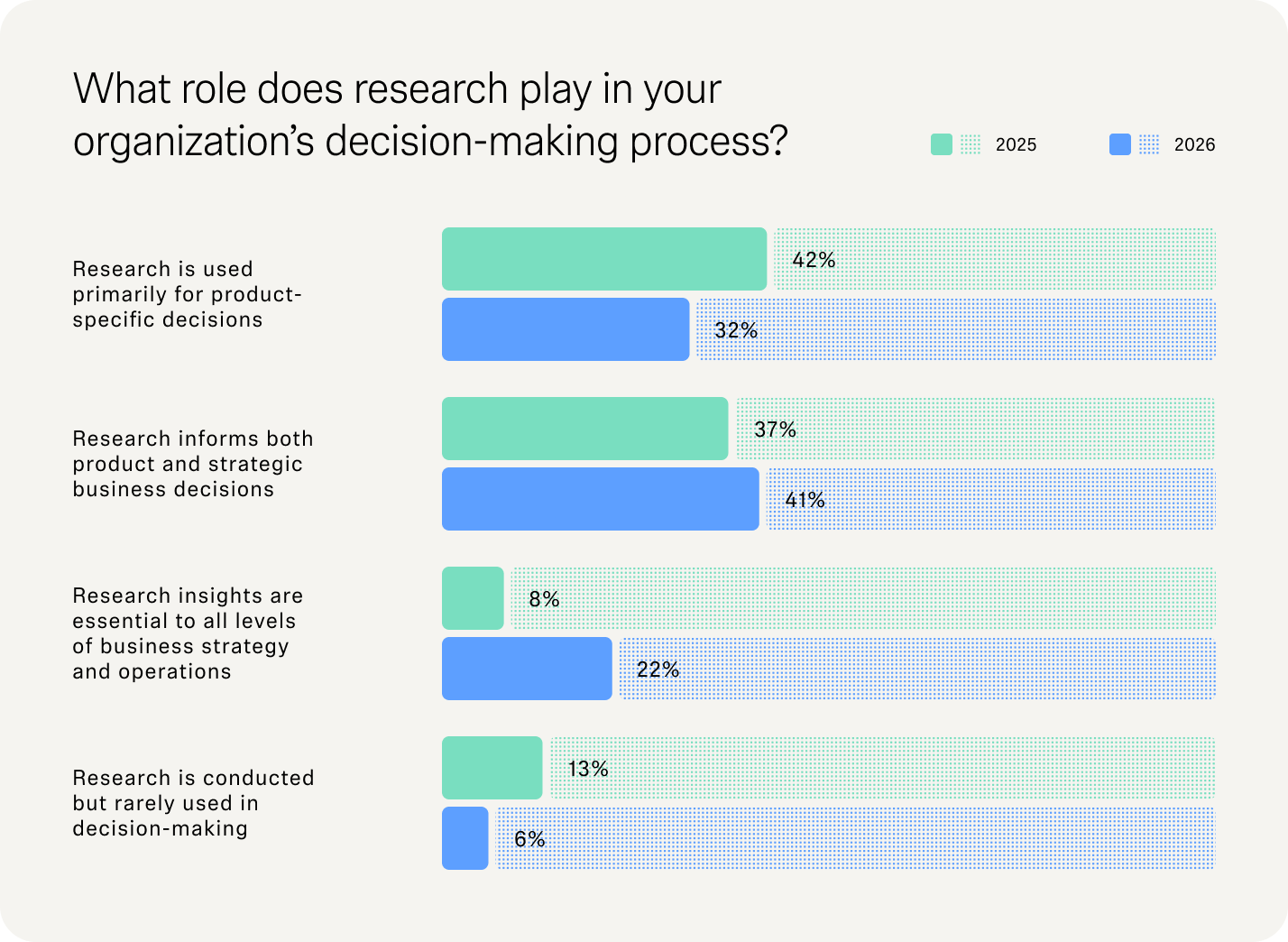
Research is no longer only about feature decisions or one-off usability tests in many organizations. It’s become a core input into how organizations set direction, prioritize bets, and make high-impact decisions. In fact, the share of organizations where research is essential to all levels of business strategy and operations has nearly tripled in a single year, from 8% in 2025 to 22% in 2026.
This signals a structural change in how organizations operate. Instead of using research exclusively to inform product decisions, more companies now use user insights as a compass for both product and business strategy, pulling research teams into the room earlier to shape long-term plans.
As a result, researchers are moving up the strategy ladder, getting embedded in key decisions, and increasingly being assessed on outcomes and impact—not just on the volume of studies they deliver. Nearly 35% of respondents say it is becoming more strategic, and 33% see it becoming more blended across product and market research.
The best researchers can triangulate business strategy, stakeholder goals, and user research to form a clear narrative about what action should be taken.


Kate Pazoles
Senior Manager, Research at Twilio
Share
This second point builds momentum by showing that as AI scales execution, research is simultaneously gaining more authority and visibility, amplifying both its opportunity and its responsibility inside the organization.
But as AI raises expectations and research gains a stronger voice in the boardroom, the pressure shifts to whether your systems, standards, and culture can keep up.
3. Pressure builds as demand outpaces systems
Demand for user research keeps rising. In last year’s report, nearly 55% of participants said demand had increased; this year, that climbed to 66%.
That demand is no longer concentrated in research teams. It has spread across the organization:
- 39% say product managers are conducting user research
- 35% say market researchers are doing it
- 23% say marketers are involved
By trusting stakeholders to drive their own research and coaching them to improve incrementally, we create an environment where quality standards can be met within the organization’s context while empowering teams to move faster.


Dave Chen
Senior Director, UX Foundations & Enablement at 1Password
Share
While this helps more stakeholders stay close to user needs, it also means more studies, more methods, and more results flowing through systems that were never designed for this level of volume.
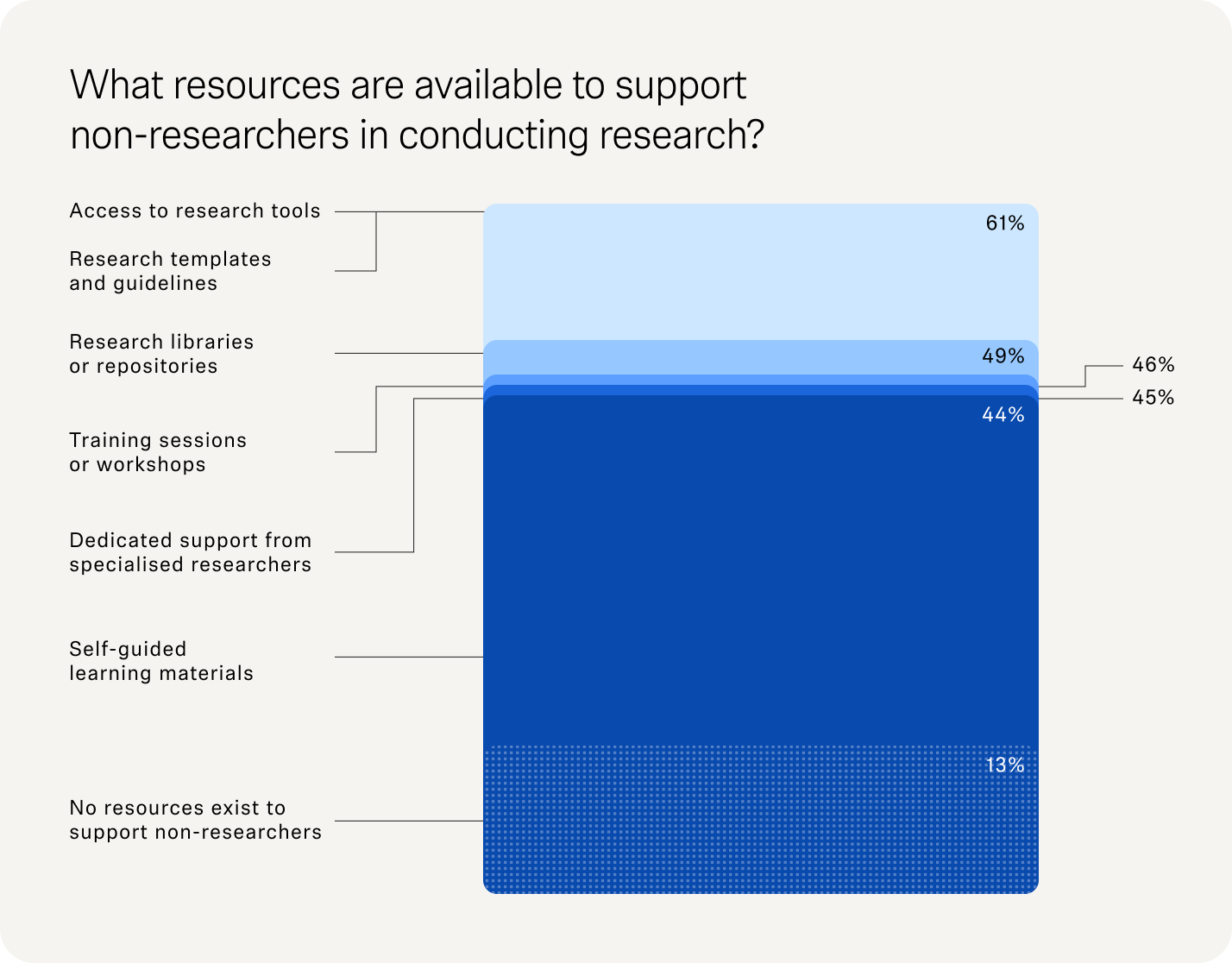
However, the infrastructure that supports research has not kept pace:
- 61% of organizations provide access to research tools and templates
- 49% have research libraries or repositories
- 46% offer training sessions or workshops
- 45% provide dedicated support from specialized researchers
- 13% have no resources at all to support non-researchers running studies
Most organizations offer basic access to tools, yet fewer than half provide the training, dedicated support, or libraries needed to keep quality consistent as research spreads across the business.

Enablement isn’t a couple of lunch-and-learns on ‘how to use our research tool’ or ‘how to run interviews.’ It’s teaching people the thinking behind good research.


Caitlin Sullivan
AI Trainer, AI Customer Research
Share
Here, the story pivots from progress to pressure. Research is spreading across the business, but enablement standards, infrastructure, and culture are lagging behind. Teams grapple with inconsistent methods, repetitive work, and insights that get lost or buried in disconnected tools, creating noise and increasing the load on already stretched research functions.
Without strong guardrails and shared practices, rising demand risks eroding trust in research quality instead of amplifying its impact.
What this means for user research in 2026
We’re used to talking about AI in research as an upcoming trend, but our report shows that it’s now firmly embedded in everyday practice. It’s transforming the way teams are conducting research.
We’re also seeing researchers step into more strategic, outcome-focused roles. With this, pressure and expectations are rising, and more teams than ever before are running research to get decision-driving insights.
This highlights a new challenge for organizations to overcome: research enablement. In order to meet this growing demand, stakeholders require additional support and guidance to run effective research—from asking the right questions to connecting insights to business outcomes.
Research has never been about data collection. It’s about distinguishing signal from noise, understanding context, and moving from observation to insights that change decisions. That’s where your value lives.


Pert Eilers
Staff Strategic Operations Manager at Adobe
Share
Research’s seat at the table has never been more real. But, in order to keep it there, organizations need to build the systems and cultures to enable success.
Download the full report to find out how.
Frequently asked questions
Is AI actually replacing user researchers?
Is AI actually replacing user researchers?
No—and the data backs this up clearly. While 69% of researchers now use AI in their workflows, human judgment is becoming more important, not less. Researchers overwhelmingly identify interpreting nuance and emotion (82%), ethical decision-making (80%), and framing the right questions (76%) as areas where human involvement is essential and can't be replicated by a tool.
Why is research influence tripling now?
Why is research influence tripling now?
The combination of AI and competitive markets has helped uplevel research from a support function to a strategic lever. AI frees researchers from time-consuming operational tasks, letting them focus more on strategy. At the same time, organizations face faster product cycles and higher stakes. Organizations need evidence-based decisions that reduce costly mistakes, and researchers can deliver the insights that drive impact.
How can researchers adapt in 2026?
How can researchers adapt in 2026?
As the role of the researchers shifts from insight producer to business partner, researchers need to step away from execution-level tasks to hone their strategic skills. Business acumen, storytelling, and stakeholder management will be the most valuable assets to clearly communicate insights and share data-backed points of view.
How can lean research teams find success in 2026?
How can lean research teams find success in 2026?
Start small and be realistic about what's achievable with gradual improvements that build momentum over time. AI has actually lowered the barrier to entry, so teams that previously lacked the capacity to run frequent studies can now move faster and create value sooner. The key is pairing that speed with enough structure to keep the work credible because credibility, once lost, is hard to rebuild.
What's the biggest risk for research teams in 2026?
What's the biggest risk for research teams in 2026?
As research spreads across more teams, inconsistencies in methods, standards, and storage create inefficiencies and hurt credibility. More research conducted without shared frameworks doesn't lead to better decisions—it leads to noise. The antidote is building infrastructure: centralized insights, quality standards, and continuous enablement.
What separates research teams that thrive in 2026 from those that lag behind?
What separates research teams that thrive in 2026 from those that lag behind?
Teams that thrive aren't just running more studies—they're building systems of learning across the organization. This goes beyond tools and templates and means building repeatable processes for continuous learning, enabling non-researchers to understand “good research,” and designing intentional AI-human workflows.