

















TL;DR
Market research helps product, marketing, and leadership teams understand which customers are in their market, what they care about, and how demand differs across segments (such as industries, company sizes, roles, or regions).
Paired with user research, it informs decisions about which customer groups to prioritize, how to position and price your product for them, and which ideas or campaigns to fund (or not fund). With tools like Maze, you can mix primary and secondary, qualitative and quantitative methods to test concepts and campaigns quickly with real audiences.
Marketing managers, brand leads, product marketers, and founders are all running studies to answer the same question: “Is this worth pushing into the market?”
Done well, market research gives you a clear view of who’s out there, what they care about, and what opportunities are on the table. It helps you avoid launching the wrong product, entering the wrong market, or pouring budget into a campaign that won’t land. It also shapes your positioning and pricing and helps you prioritize the ideas that are most likely to work.
In this guide, we walk through the core types of market research, the methods you can use, where it differs from user and product research, and examples to inspire your next study.
What is market research and why is it important
Market research is the structured process of understanding your market, customers, and competitors to make better business decisions. It helps you identify who your customers are, how many of them there are, what problems they are trying to solve, and how much demand exists. It also helps understand how your brand and product compare to alternatives through systematic data collection and market analysis.
While user research focuses on how people use your product, market research zooms out to look at demand, consumer behavior, brand perception, and competitive positioning. The value is in how they connect. Market research helps you decide which opportunities, audiences, and value propositions to focus on, and user research gets into the details of how those decisions play out in the product experience.
For Product and Marketing teams, market research answers questions like:
- Is there actually demand for this?
- Which message will land with our audience?
- How does our brand compare to the competition?
These insights shape your positioning, pricing, and where you invest your energy and budget.
📌 Market research is no longer limited to specialist market researchers. Marketing managers, product marketers, brand teams, PMs, and insights roles all typically run market research as part of their jobs, using it to de-risk launches and keep strategy grounded in real-world demand.
Market research vs. user, customer, and product research
Market research, user research, customer research, and product research are used interchangeably, but they solve different problems:
- Market research shows where the opportunity is
- Product and user research analyze how those bets perform in the product
- Customer research shows what that means for revenue, retention, and risk
Here's a quick breakdown:
Research type | Level of zoom | Core questions | Typical inputs | Typical outputs |
|---|---|---|---|---|
Market research | Market level |
| Large surveys, panels, syndicated reports, campaign tests | Customer segments by industry, size, role or region, demand, concept and message lift |
User research | Experience level |
| Usability tests, prototype tests, in-product studies | Usability issues, friction points, behavior patterns |
Customer research | Relationship level |
| NPS and CSAT surveys, churn and win/loss interviews, support data | Drivers of loyalty, risk signals, churn drivers |
Product research | Opportunity level |
| Concept tests, pricing studies, feature surveys, prototype feedback | Prioritized problems, feature and pricing direction |
A researcher or insights lead often sits across this whole picture, collecting data from each research type, framing the combined evidence as risks, options, and trade-offs, and making it easier for PMs, designers, and marketers to act on the same set of facts.
When to use market research vs. user research
Market research targets broad market segments, while user research focuses on the profiles that could or do use your product. They answer very different questions. If you start with the wrong one, you either over-engineer a bad idea or under-invest in a great one.
Choose market research when:
- You’re deciding which idea to back. New concept, campaign route, proposition, or brand territory.
- Your research stimuli are finished or near-finished assets like static ads, video storyboards, landing pages, taglines, pricing options, or packaging.
- You need comparative answers. You want to know which option performs better, by how much, and with which segments.
- You need statistical confidence to defend a recommendation to leadership or justify a big commercial decision.
- You’re evaluating opportunities across the entire market, sizing demand, defining segments, testing positioning, or prioritizing territories.
- You want evidence that supports a campaign, guides roadmap priorities, and helps design teams focus on the right journeys.
Market research behaves like a decision engine. It compares options side by side and uses quantitative methods to answer: “Which one wins in this market, for this audience, under these conditions?”
Choose user research when:
- You’re shaping how an idea works in the product after you have already decided to pursue it.
- Your stimuli are interactive. Figma prototypes, live flows, onboarding, checkout, or feature journeys.
- You want to see what people do, not just what they prefer. Can they complete the task? Where do they hesitate? What do they miss?
- You’re trying to remove friction, improve clarity, or raise conversion in specific parts of the experience.
- You’re iterating quickly and need directional feedback on designs, copy, or interaction patterns.
User research behaves like an experience microscope. It zooms into the fine detail of behavior and usability, not the macro question of whether the concept should exist in the first place.
How they work together
You need both.
- Use market research to choose the right opportunity, audience, and value proposition
- Use user research to make sure that the opportunity is delivered clearly and confidently in the product
When this flow works well, insights move in both directions. Concept tests and demand studies inform design briefs and roadmap priorities. In turn, usability studies and in-product behavior give Marketing and Sales concrete input for campaign copy, sales enablement, and positioning, so the story you tell outside the product reflects what actually happens inside it.
💡A simple way to think about it:
- Start with market research when the question is “Which opportunity or concept could/should we pursue?”
- Follow with user research when the question shifts to “Does this solution work for real people in the product, and how can we improve it?”
Types of market research (with examples)
Most teams work with four core types of market research:
- Primary research and secondary research, which describe where your market data comes from
- Qualitative research and quantitative research, which describe how you collect and interpret data
In practice, you rarely use just one. A typical study might combine secondary market research to understand the global market landscape, primary research to hear from potential customers, qualitative methods to explore attitudes, and quantitative methods to validate findings at scale.
Let’s look at each of these market research types and where they fit in your research process.
Primary research
Primary research is any market research where you collect new data directly from your target audience instead of relying on existing reports. You design the study, recruit participants, and control the questions, timing, and context.
Marketing teams use it for:
- Testing campaign concepts and creative work
- Validating product ideas before launch
- Measuring brand perception and tracking market trends
- Understanding buying decisions and customer behavior
The method you choose—quantitative or qualitative—depends on your research question. Testing concepts often uses quantitative comparison, while understanding motivations requires qualitative depth.
Secondary research
Secondary research means using data that already exists rather than collecting it yourself. You're digging into data from published reports, industry analysis, existing studies, and market intelligence to frame your strategy before committing resources to primary research.
Marketing professionals rely heavily on this approach. They analyze in-house consumer data and also use syndicated data sources—paid reports from firms such as Statista, Mintel, and Nielsen that provide detailed charts, competitor benchmarks, and market forecasts.
Beyond paid syndicated data, teams also draw on public-domain sources and academic and industry reports to build market context. The goal is to gain a broader perspective, frame categories, understand where the market is heading, and identify gaps competitors aren't addressing.
Quantitative research
Quantitative research tells the macro story. It gives you numbers, statistical confidence, and the ability to say "X% of our target audience prefers this option". It's about scale, repeatability, and proving decisions with data that leadership can defend.
In a market research context, quantitative studies usually look like:
- Concept tests that measure appeal, clarity, and purchase intent for new products or campaign ideas
- Brand trackers that monitor awareness, consideration, and preference over time
- Ad testing that compares recall, message takeout, and likelihood to act across creatives
- Market sizing and segmentation studies that estimate market size and how different groups behave
Sample sizes for quantitative research are usually large. Teams often aim for 100–5,000 respondents, depending on budget, how many segments they care about, and how precise they need the numbers to be for a market research report.
Qualitative research
Qualitative research focuses on understanding the ‘why’. It captures emotions, perceptions, and motivations through conversations and narrative feedback.
In market research, qualitative work typically uses:
- In-depth user interviews to explore perceptions, emotions, and decision drivers
- Focus groups to hear how people react to ideas together and build on each other’s language
- Unmoderated think-aloud tasks where people react to ads, landing pages, or concepts while they talk through their thoughts
- Diary studies or in-home usage tests to see how attitudes evolve as people live with a product over time
Sample sizes are typically smaller than in quantitative research—around 5–15 participants per segment—because qualitative research prioritizes identifying patterns in how people think and feel, not measuring how many people think that way.
How to conduct market research step-by-step
Running market research doesn't have to be overwhelming. With an AI-first user research platform like Maze, you can move from question to actionable insights in days. Here's a quick framework you can follow, whether you're testing a campaign concept, validating pricing, or measuring brand perception.
1. Define objectives
Start with the question you're trying to answer. Are you testing brand perception? Exploring demand for a new product concept? Understanding why customers choose competitors?
Good objectives are specific and measurable. For example:
- Determine which of three potential product positioning strategies resonates most with small business owners in the healthcare sector
- Measure brand awareness and perception compared to three key competitors in the European market
- Identify the most valued benefits and deal-breakers when enterprise buyers evaluate project management software
- Understand willingness to pay for a subscription-based model versus one-time purchase in the productivity tools category
You also need to decide what success looks like. Write down three to five KPIs you'll track after launch so you know if your decisions paid off. These might include metrics like brand recall lift, market share growth in target segments, conversion rate on new messaging, or customer acquisition cost in priority markets.
In practice, writing your learning goals directly into your research platform ensures they stay front and center throughout the study. Maze's AI moderator uses these goals to guide interviews and tailor follow-up questions automatically. Your objectives also shape how the AI analyzes responses and generates thematic insights.


2. Identify your audience
You need to get specific about demographics (age, location, income), behaviors (purchase frequency, product usage), and psychographics (values, lifestyle, attitudes). For example, don't say ‘parents’, say ‘parents of children under five who buy organic food and live in suburban areas.’ The more precise you are, the better your insights will match real market behavior.
Create a screener to qualify participants with questions like:
- What's your age range?
- Have you purchased [product category] in the last six months?
- Which brands have you used?
- What's your household income?
- Where do you live?
Screener questions help ensure you’re talking to the right profiles within the market. In Maze, when you set up your study, you can add these screener questions in the recruitment settings.
3. Choose your method
Your research question helps determine your method.
Need to understand why people feel a certain way? Go qualitative. Need to prove ‘how many’ prefer option A over B? Go quantitative.
You need to match your method to your objective:
Your goal | Best method | Why |
|---|---|---|
Measure brand awareness and perception vs. competitors in a new market | Quantitative survey with brand tracking questions | Large sample sizes let you compare your brand to competitors with precision and defend recommendations to leadership |
Understand why buyers choose competitor products over yours | Qualitative interviews with customers who left or chose competitors | Captures decision drivers, perceived gaps, and the exact language buyers use when comparing options |
Size the addressable market for a new product category | Quantitative survey with screening and behavioral questions | Validates demand at scale and identifies which segments are worth targeting |
Explore unmet needs in an adjacent market before expansion | Qualitative focus groups or interviews | Uncovers pain points and opportunities your current offerings don't address |
Test willingness to pay across different pricing models | Quantitative survey with conjoint analysis or price sensitivity testing | Shows which features buyers will pay more for and finds the price point that maximizes revenue without losing customers |
Often you'll use both—run qualitative first to explore, then quantitative to validate at scale.
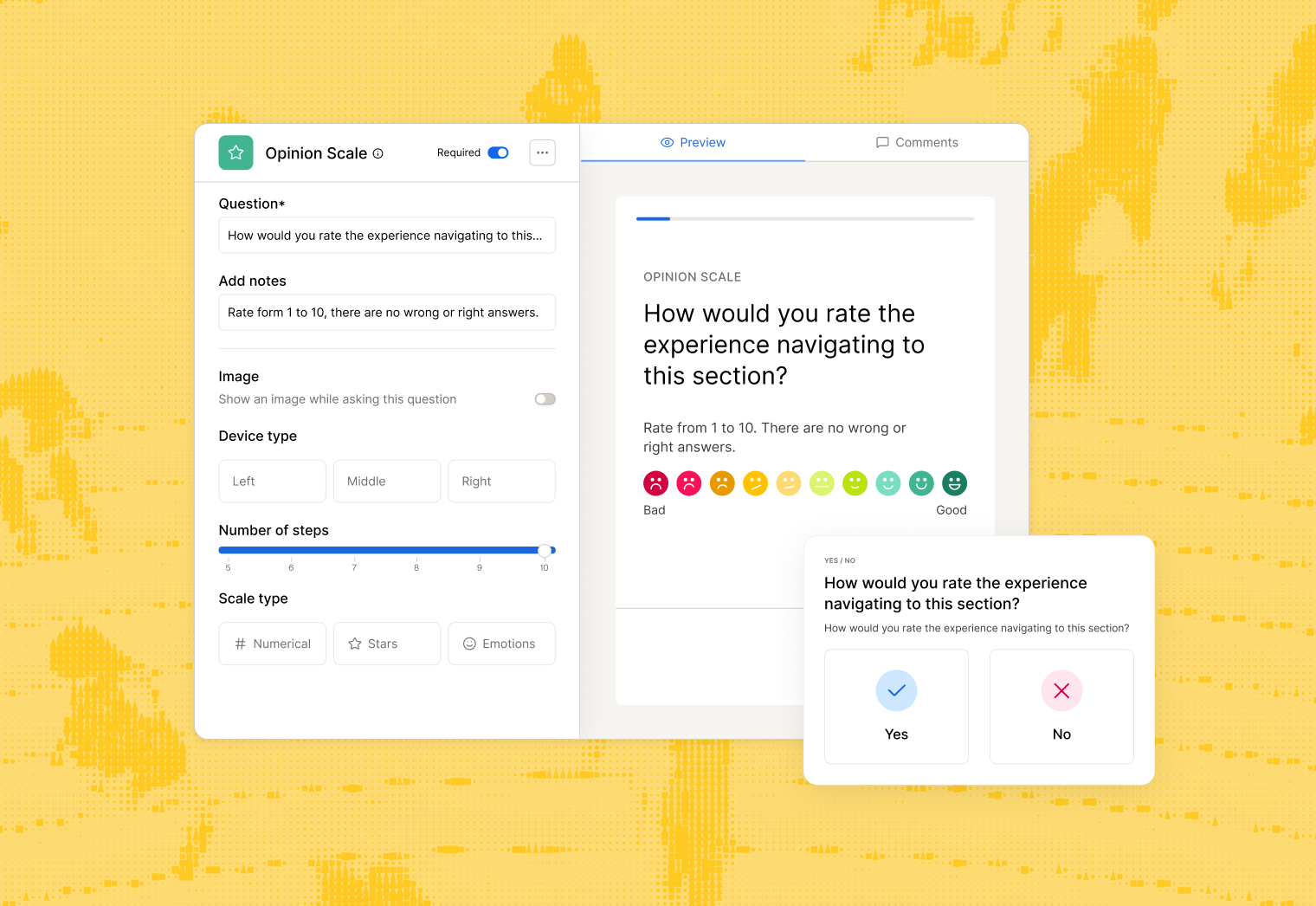
Maze supports AI-moderated interviews for scalable conversations that probe deeper based on responses and unmoderated tests where participants complete tasks at their own pace. You can also run surveys with multiple-choice and rating scales, and diary studies where participants log feedback over days or weeks.

🎬 Curious about AI-moderated interviews?
Watch Maze’s webinar 'The Future of Research with Maze’s AI Moderator' for a quick look at how teams use AI-moderated interviews to scale qualitative research.
4. Collect your data
Now you’re ready to launch your market research study and collect responses. Decide on your sample size first. You’ll need around five to 15 participants for qualitative research and 100 to 5,000 for quantitative, depending on how many segments you're testing and the statistical confidence you need.
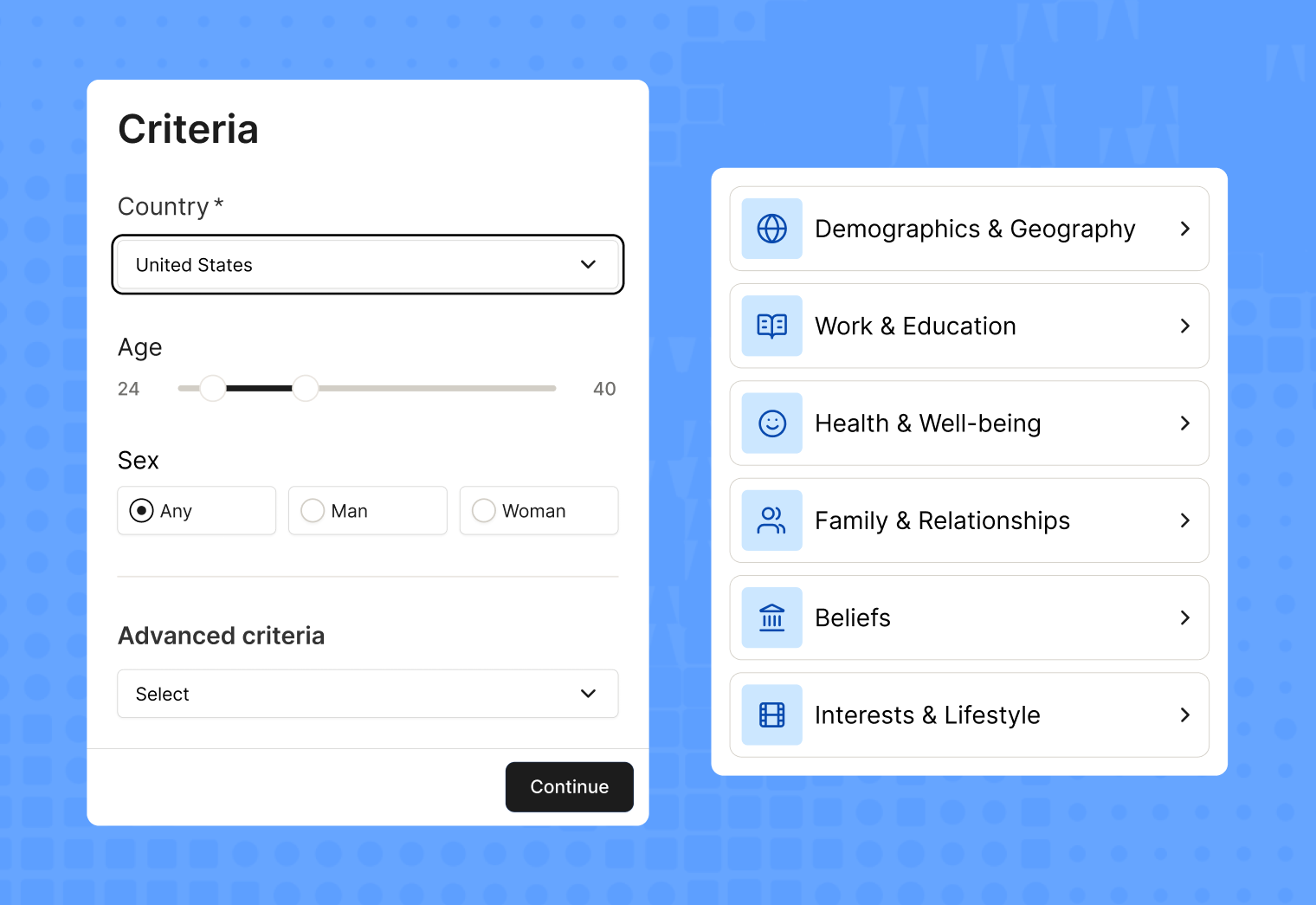
Maze Panel gives you access to millions of B2B and B2C participants across 150+ countries with 400+ filters like demographics, profession, industry, technology use, shopping behavior, and lifestyle habits. Select your criteria, set your sample size, and Maze recruits, screens, and delivers qualified participants automatically.
For your own audience, use Maze Reach to send studies via email to customers, prospects, or internal teams. You can upload your list, segment by criteria, and send personalized invitations with tracking and reminders built in.
Once you’ve recruited participants, the quality of your data depends on your study. For quantitative studies, check that responses are distributed across your target segments so you're not accidentally over-indexing on one group. Monitor response rates as they come in and watch for drop-off points that might signal confusing questions or survey fatigue. For qualitative interviews, keep sessions focused on your original objectives while staying flexible enough to explore unexpected themes that emerge.

5. Analyze results
This is where you look for themes in qualitative feedback, statistical significance in quantitative data, and segment-specific differences that reveal how different audiences respond.
Maze automatically generates reports as soon as participants start completing your study, like:
- Survey visualizations: Automatic charts and percentages for multiple choice, opinion scales, and rating questions, filterable by demographic segment
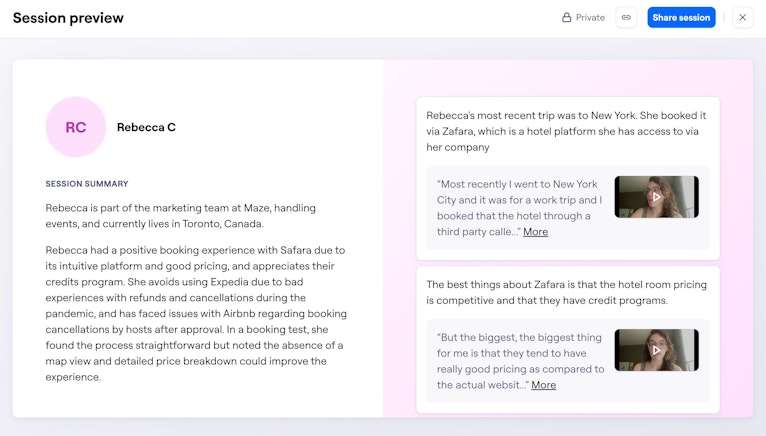
- AI thematic analysis: Interview transcripts and open-ended responses automatically grouped into themes with traceable quotes, patterns, and sentiment analysis provided
- Segment comparison: Side-by-side results when testing multiple audience segments, showing which responded differently and how
You can customize reports with custom slides, remove sections, reorder content, and hide or show specific responses. This makes it easy to add context from secondary research—like industry benchmarks, competitor analysis, or market sizing data—directly alongside your primary research findings. Your team can comment directly on reports to discuss findings and align on next steps.
Plus, you can share reports as live links (no Maze account needed), download PDFs for presentations, or embed directly into Notion, Confluence, Slack, or your roadmap tool.

6. Act on your findings
At this stage, you should be able to answer questions like:
- Which concept are we backing, and why?
- How does this influence our marketing strategy, messaging, or positioning?
- What should we change in the product roadmap, pricing, or go-to-market plan?
- What do we need to stop doing because the data doesn’t support it?
Quote the language participants used in your research to humanize your recommendations and make them stick with stakeholders. For example:
- Brand perception shows you're seen as ‘expensive but outdated’? → Recommend a visual refresh paired with messaging that emphasizes innovation without changing pricing
- Concept B outperformed A by 35% in direct success rate? → Delete concept A and move forward with B immediately
- Pricing research reveals willingness to pay peaks at $29/month, not your planned $49? → Adjust tier structure or strip features to hit that price point
- Campaign testing shows your tagline confuses people? → Rewrite it before launch using the language that actually resonated in testing
7. Measure success and iterate
After launch, measure what happened. Did brand perception change? Did purchase intent translate to conversions? Did the campaign perform better than your baseline? Track your KPIs, compare them to your benchmarks, and figure out what worked and what didn't.
Here are a few KPIs worth tracking:
- Brand awareness (did more people recognize you?)
- Brand perception scores (are you seen the way you want to be?)
- Purchase intent or actual conversion rates
- Customer satisfaction (NPS, CSAT, CES scores)
- Market share gains in your category
- Campaign engagement, click-through, or ROI
- Feature adoption or product usage metrics
Market research is a cycle. Launch, measure, learn, and iterate. You should keep testing new hypotheses based on what you discovered and keep building on what you learn.
Each study gets you closer to understanding what really drives decisions in your industry—and that's how you stay ahead.
How does Maze fit in a market research strategy
Maze fits into a market research strategy as the platform for finding and screening participants, conducting quantitative and qualitative primary research, and analyzing data collected during market research for both Marketing and Product teams. It’s strongest when you need rich, fast feedback on campaigns, concepts, and brand messaging, not when you’re running large, complex quantitative market studies or long-running tracking programs.
Because Maze also supports a wide variety of research methods—like prototype and usability testing—it can sit across both market research and user research, so the same tool that validates a concept can later be used to test how that concept performs in the product.
Maze aligns closely with how Marketing and Product teams already do market research, especially when they need to:
- Explore market opportunities and unmet needs: Conduct interviews with target segments to understand their challenges, buying criteria, and gaps competitors aren't addressing. Identify which pain points matter most before deciding which ones move into product discovery, design briefs, and roadmap discussions.
- Test positioning and messaging strategies: Present different value propositions or brand territories to your audience and measure which resonates most strongly. Understand how people interpret your positioning and what language they use naturally, then reuse that language in UX copy, in-product education, and onboarding flows so the experience matches the promise.
- Measure brand perception and competitive standing: Capture how people describe your brand versus alternatives, what associations they hold, and where you sit in their consideration set. Use open-ended questions and AI follow-ups to go deeper than satisfaction scores, and give both Marketing and UX a clearer picture of which expectations the product experience needs to live up to.
Under the hood, Maze supports these use cases with AI-powered qualitative research methods like AI-moderated or unmoderated interviews, open-ended questions with AI follow-ups, rating scales, and thematic analysis that turns raw feedback into patterns your team can act on. The same workflows and question types are used for UX studies in Maze, which makes it easier to link market-level insight to what you later test in prototypes or live flows.
Use Maze to explore perceptions, test positioning strategies, and uncover unmet needs through interview studies and surveys—then layer those insights with market sizing data, competitive benchmarks, or statistical analysis from other sources.
From there, Product and UX teams can push the best concepts straight into prototype tests and usability studies in Maze. And what you learn from those tests about language, friction, and mental models can flow back into campaign creative, brand messaging, and sales enablement.
Instead of running market research and user research as separate projects, Maze helps you build a single system of learning that supports decisions across the organization.
Market research in action: Identifying opportunities
Let’s say you’re a SaaS company launching a new project management tool for small businesses. You’re keen to understand the market you’re about to enter, specifically the competitors that already exist and what customers think of them. You want to understand what’s currently out there so you can improve on it—winning over customers and becoming the go-to.
You've identified three potential positioning strategies, but you're not sure which will resonate most with your target market of small business owners.
Research objective: Determine what problems your target customers currently have with their existing project management solution.
The approach:
You recruit 200 small business owners (50-250 employees) through Maze Panel, screening for those who currently use or are considering project management software. You split them into three groups: one for teams using Competitor A, one for Competitor B, and a third for Competitor C.
For the quantitative layer, you ask each group to rate satisfaction with their existing solution, perceived value, price elasticity, and willingness to switch. Maze automatically generates comparison charts showing which concept scores highest across segments.
For the qualitative layer, you include open-ended questions: "What is your favorite thing about [competitor product]?" and "What do you wish it did better?" Maze's AI groups responses into themes, revealing that all customers wish their PM solution offered more finance features.
You also conduct 10 follow-up AI-moderated interviews with respondents who showed high switching intent. The AI probes deeper into decision criteria, current pain points, and what exactly would make them switch from their existing tool.
The outcome:
Within five days, you have a clear list of opportunities for developing a more advanced project management solution for small businesses. You know what customers like and dislike, what they’re willing to pay, and under what conditions they’d make a switch.
You combine these findings with secondary research on market size and competitor positioning, then present a unified report to leadership with clear direction on which strategy to pursue.
Merging market research and user research for a complete picture
Market research and user research are still different disciplines, but they’re no longer owned by completely different teams. The traditional boundary between research and analytics is dissolving, with research professionals shifting toward strategic consulting rather than purely executing studies.
Research leadership at Fortune 500 companies now manages both Marketing and UX researchers under one function. Teams want one platform that handles concept validation, messaging tests, brand perception studies, and prototype testing.
This shift changes how you think about your research practice.
Market research and user research work best as one loop, and Maze fits into that merged model as a shared environment for modern insight work. It gives marketers, Product teams, and researchers one place to conduct research with real audiences, so market- and user-level questions feed the same decisions instead of competing for attention.


Frequently asked questions about market research
What is market research?
What is market research?
Market research is the structured process of understanding your market, customers, and competitors so you can make better business decisions. It looks at market size, target market, customer segments, pricing expectations, and how people perceive your brand and category.
How is market research different from user, UX, and customer research?
How is market research different from user, UX, and customer research?
Market research looks at the wider market, demand, positioning, and competitive landscape. User and UX research focus on how people experience your product or prototype, while customer research looks at ongoing satisfaction, loyalty, and reasons people stay or churn.
When should Product teams run formal market research?
When should Product teams run formal market research?
Product teams should run formal market research when they need to investigate whether a new opportunity exists and is worth pursuing. That includes exploring new product categories, assessing new markets or regions, understanding competitive landscapes, examining pricing models, or identifying unmet customer needs before deciding what to build.
What are the main types of market research?
What are the main types of market research?
The main types are primary and secondary research (whether you collect new data or use existing sources), and qualitative and quantitative research (whether you focus on depth and stories or numbers and scale). Most effective market research projects combine at least two of these—using insights from conversations to shape what you measure at scale, or using survey data to identify which audience segments need follow-up interviews.
What metrics or outputs should I use on a market research project?
What metrics or outputs should I use on a market research project?
For quantitative work, typical outputs are awareness, consideration, preference, purchase intent, concept appeal, and simple segmentation splits (for example, by role, company size, or region). For qualitative work, the outputs are themes, language, and clear recommendations that turn findings into next steps for product, marketing, or business strategy.
How does Maze support market research use cases?
How does Maze support market research use cases?
Maze supports market research by giving teams one place to run surveys, interviews, concept tests, messaging and creative tests, and brand perception studies with real audiences.
You can combine surveys, rating scales, and AI-moderated interviews, then recruit participants from your own database with Reach or from external audiences with Maze Panel to get fast, actionable insights.