








Chapter 2
Win-Loss Analysis: What It Is and How It Works
TL;DR
Win-loss analysis helps you understand why buyers choose your product or go with a competitor instead. It starts with a focused sample of recent won and lost deals, then uses buyer interviews to uncover what shaped each decision.
From there, you look across those conversations for patterns that repeat, weigh how much each one matters, and turn the strongest ones into changes your teams can act on. Track your win rate and win-loss ratio over time to see whether those changes are helping you win more and lose less.
A win-loss analysis helps you understand what influenced a buyer’s decision to buy, or not buy, your product. It goes beyond what’s captured in CRM data or a sales debrief; when you speak directly with buyers, you get the context behind outcomes—whether positive or negative. Their feedback can reveal how your positioning, product, pricing, or sales process influenced their decision.
In this chapter, we’ll cover how to:
- Plan and run a win-loss study
- Select the right won and lost deals
- Structure interviews and ask better questions
- Analyze findings and report recurring patterns
- Measure success, including win rates and B2B SaaS benchmarks
First, let’s start with the fundamentals.
What is win-loss analysis?
Win-loss analysis is the process of collecting and analyzing feedback from buyers after a sales opportunity closes. It involves hearing directly from buyers about what shaped their decision and looking for patterns across won and lost deals.
While the customer and user research we covered in Chapter 1 looks more broadly at the overall experience, win-loss analysis zooms in on one specific moment: what drove the buying decision.
The aim is to dig deeper to understand the true why behind buying decisions. For example, a lost deal might be put down to price, but the real issue could be weak differentiation, an unclear value proposition, or a sales experience that failed to build confidence. Customers can say one thing but mean another—and win-loss analysis is how you uncover the underlying truth.
When you analyze win-loss patterns over time, different teams can use them in different ways:
- Product marketing can improve competitive positioning, messaging, competitive intelligence, and sales enablement
- Sales reps can see where deals gain or lose momentum and improve future conversations
- Product teams can spot recurring needs or gaps that influence buying decisions
- Leadership and other C-suite stakeholders can use buyer feedback to guide broader go-to-market strategy
💡 Win-loss analysis zooms in on one specific moment: what drove the buying decision.
Why teams run win-loss analysis
A single sales debrief gives you one person’s view of one deal. A structured win-loss program lets you compare buyer feedback across multiple deals, test internal assumptions, and see which patterns repeat over time.

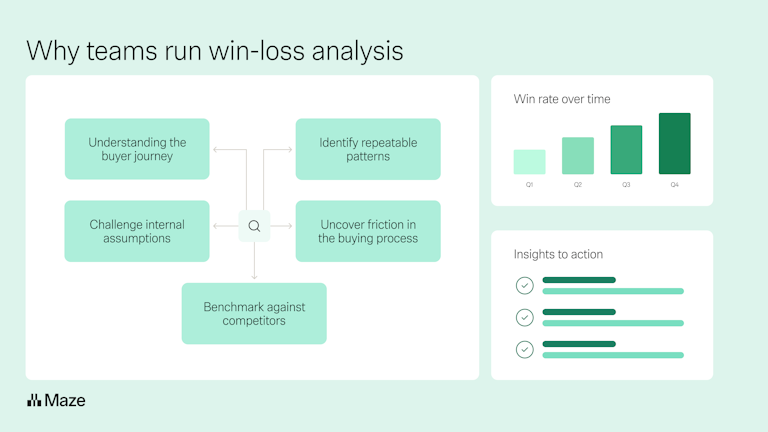
Teams run win-loss analysis to:
- Reconstruct the buying journey: Understand what triggered the search, how buyers built their shortlist, which criteria mattered during evaluation, and what finally shaped the decision.
- Challenge internal assumptions: Compare what your team believes influenced a deal with what the buyer says actually made a difference. A loss attributed to price, for example, may have more to do with differentiation, perceived risk, or confidence in the solution.
- Identify repeatable win and loss drivers: Search interviews for factors that consistently help or hurt deals. Get a better basis for deciding which problems need attention, rather than treating every lost opportunity as a one-off.
- Understand how buyers compare you with competitors: Learn which alternatives make the shortlist, where buyers see meaningful strengths and weaknesses, and what they believe each option does better. This gives you buyer-led competitive insight so you don’t have to rely on internal battlecards or competitor assumptions.
- Find friction in the buying process: Understand how buyers perceive your value, evaluate your product, get internal buy-in, or feel confident about implementation. This helps you understand why you weren’t picked despite your product being a strong fit.
- Track how buying criteria change: Run the win-loss research continuously to see when buyer priorities shift, new competitors enter consideration, or previously important decision factors start to matter less.
The aim is to collect enough buyer feedback over time to spot recurring patterns and make better decisions.
How to conduct a win-loss study
A win-loss study works best when you use a consistent approach across the deals you select, the interviews you run, and the way you analyze the findings. Here’s how to structure the process from start to finish.
Selecting which won and lost deals to study
Start with the question you want the study to answer; your why for running the study. This could be:
- Why do enterprise buyers keep choosing Competitor X over us?
- What's driving our declining win rate in the mid-market segment?
- Why do deals not close during the evaluation stage?
Your sample should include deals that can speak to that question. For example, if you want to understand why enterprise buyers keep choosing Competitor X, focus on recent enterprise deals where that competitor made the shortlist. Deals like these share the same segment, competitor, and buying context, which makes it easier to compare interviews and spot patterns across them.
When building your sample:
- Include both wins and losses: Wins help you understand what influenced buyers to choose you, while losses show what pushed them toward another option.
- Prioritize recent deals: Buyers are more likely to remember the details of their evaluation when you speak to them within a few months of the decision.
- Choose deals that reached meaningful evaluation: Late-stage opportunities usually give you more to learn from because buyers seriously compared options and formed clearer opinions.
- Keep your research cohort focused: Segment deals by factors that matter to your question, such as product, company size, geography, buyer type, or competitor.
- Avoid cherry-picking: Don’t select only enthusiastic customers, obvious losses, or deals Sales feels comfortable revisiting. Use clear criteria so the sample reflects the decisions you actually want to understand.
Designing the interview
Once you’ve selected the deals you want to study, turn those research priorities into an interview guide. Keep a core set of questions consistent across interviews so you can compare responses later, but leave enough room to follow up when a buyer raises something important.
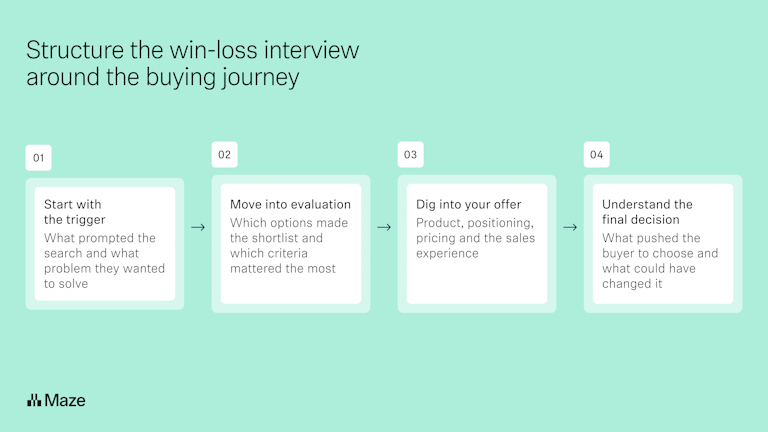
Your win-loss interview questions should stay open-ended and neutral. One effective way to structure them is to move through the buying journey chronologically, so the conversation flows the way the decision actually unfolded:
- Start with the trigger: What prompted you to start looking for a solution?
- Move into evaluation: How did you decide which options to consider? Or what mattered most when you compared the alternatives?
- Dig into your offer: What stood out about our product during the evaluation? Or how did pricing factor into your decision?
- Understand the final decision: What ultimately led you to make your final choice? Or what could we have done differently?
Questions should be specific to what you’re aiming to learn. Avoid questions that already assume something went wrong, such as "What did our sales team do poorly?" Instead, ask what the buyer's experience was like and probe further if they raise an issue themselves.
Let’s say a deal stretched on for months longer than expected. Don't ask "Why did our sales team take so long to close this?" That puts the buyer on the defensive. Instead, ask, "Walk me through what happened between your first call and your final decision."
If they mention waiting weeks for a follow-up, that's your opening. Then you can dig deeper with"What was going through your mind during that wait?" Or "Did that delay change how you felt about moving forward with us?"
Aim for around 20 to 30 minutes per interview. Use that time for questions only they can answer, rather than details you can pull from your CRM, LinkedIn, or other internal records.

Human-led vs. AI-assisted moderation
Once you have your interview guide, decide how you want to run the conversations. You can moderate interviews yourself, use an AI moderator, or combine both depending on the type of deals you’re studying.
Human-led interviews work well when the conversation needs more judgment in the moment. An experienced interviewer can notice hesitation, probe an unexpected comment, or change direction when a buyer raises something more important than the original question. This can be useful for strategic accounts, complex buying committees, or deals where several priorities shaped the decision.
AI-assisted moderation helps you scale those conversations without adding the same amount of moderator time. With Maze’s AI moderator, you can set your learning goals, add context about your company or product, and choose how structured you want each conversation to be. The AI moderator then asks relevant follow-up questions in real time based on what each participant says.
Plus, Maze’s AI Moderator is designed with research-grade AI, avoids leading questions, minimizes bias, and keeps every conversation grounded in your research goals and what participants say.

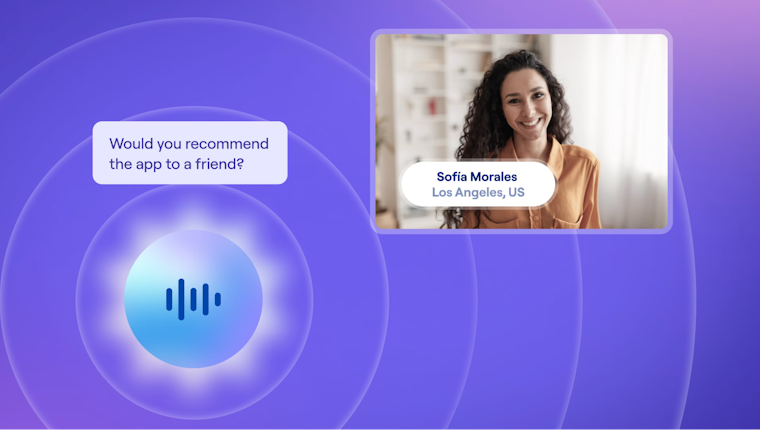
A great option is to combine both approaches:
- Use human-led interviews when you need more flexibility or want to explore complex deals in depth
- Use AI-moderated interviews when you want broader coverage across more won and lost deals
Make sure to keep the same core interview guide across both interview approaches so you can compare findings more consistently.
Whichever approach you choose, keep human judgment in the loop. In Maze’s 2026 State of Market Research Report, 96% of participants agreed that reviewing AI-generated outputs is essential. AI can help you collect and organize more buyer feedback, but your team still needs to interpret what those patterns mean for product, marketing, sales, and strategy.
Analyst synthesis and reporting
Once the interviews are complete, bring the findings together across won and lost deals. Look for themes that repeat, then compare how often they appear, which types of deals they affect, and whether they appear differently in wins and losses.
Start by grouping feedback around the areas you explored in your interviews, such as buying criteria, product fit, pricing, positioning, competitors, and sales experience. Then look across those themes to answer questions like:
- Which factors consistently influence wins or losses?
- Where do won and lost buyers describe the experience differently?
- Do certain themes appear more often by segment, deal size, product, or competitor?
- Which findings challenge what your team already believed about the buying decision?
Your analysts need to weigh three things before turning a theme into a recommendation.
First, how many buyers mentioned it. A theme that shows up in two of 20 interviews doesn't carry the same weight as one that shows up in 15.
Second, how much it shaped the outcome. A buyer might mention onboarding in passing, then say pricing is what made them walk away—frequency alone won't tell you which one mattered more.
Third, where it appears. Is it only in losses to one competitor, or does it appear across wins and losses alike? If it's tied to one segment, that points to a targeted fix. If it spans every deal type, you're probably looking at something that belongs on the product roadmap.
When you weigh all three together, a passing comment becomes a clear next step, like adjusting a pricing tier or updating a competitive battlecard.
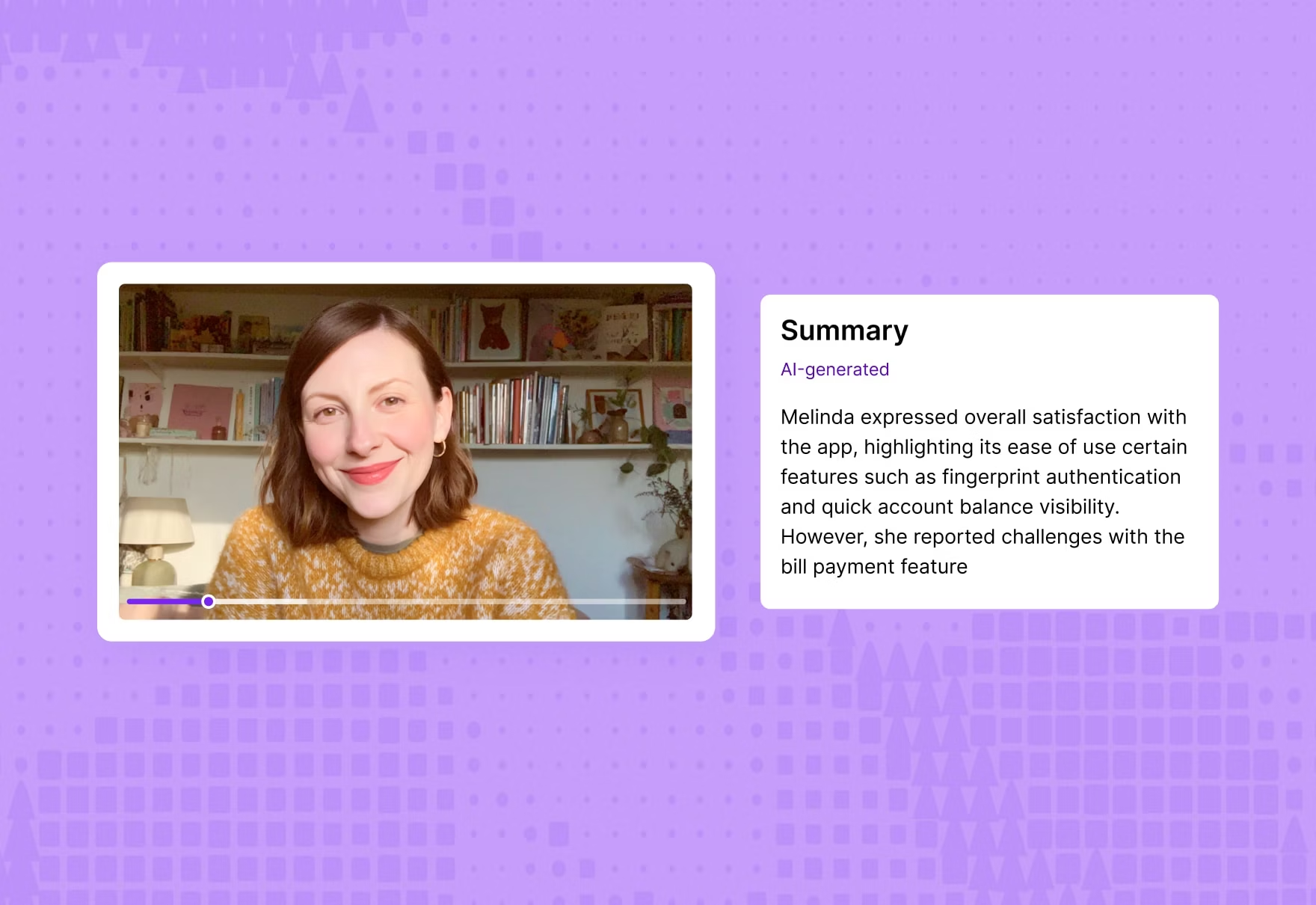
Maze AI generates transcripts, summaries, and timestamped highlights for both researcher-led and AI-moderated sessions, then uses thematic analysis to identify patterns across participants. You can review and edit those themes, check the source highlights, and refine the findings before you share them.

How in-depth does a win-loss study need to be?
There’s no fixed number of interviews you need for a win-loss study. Start with a focused group of comparable wins and losses, then keep interviewing until you can see recurring themes rather than isolated opinions.
For an initial study, five interviews can give you useful qualitative insight, but you’ll usually need more before you can confidently compare patterns across deals.
Some win-loss practitioners work toward around 10–20 interviews or more, especially when they want to compare wins with losses or break findings down by competitor, segment, or product.
Some specialist providers scope focused win-loss projects at around four to six weeks, while larger programs may run for a quarter or continue year-round. Treat that as a planning benchmark, since the size of your sample and how quickly buyers agree to participate will have a much bigger effect on timing.
Measuring ROI and success of win-loss analysis
Win-loss analysis takes time and effort to run well, so it's worth knowing whether it's paying off. That means tracking how your sales performance and related numbers move once your findings shape decisions. Start with a baseline before you make any updates, then compare your win rate and related metrics over the following quarters.
Your win rate is the first place to start:
Win rate = closed-won deals ÷ (closed-won deals + closed-lost deals) × 100
For example, let’s say you closed 100 qualified opportunities in a quarter. You won 25 and lost 75. Divide the 25 wins by all 100 closed opportunities, then multiply by 100. Your win rate is 25%, meaning you won one in every four deals that reached a final outcome.
You can also track your win-loss ratio, which looks at how wins compare directly with losses, rather than as a share of every deal closed:
Win-loss ratio = closed-won deals ÷ closed-lost deals
So, if you won 25 deals and lost 75, your win-loss ratio is 0.33. That's because 25 divided by 75 simplifies to 1/3—meaning you won one deal for every three you lost.
The key difference is that win rate looks at wins as a share of all closed deals, while win-loss ratio compares wins directly with losses. Using the same example, your win rate is 25%, but your win-loss ratio is 1:3.
From there, break the numbers down to see where your win-loss research is delivering that ROI:
- Competitive win rate: Track how often you win when a specific competitor appears in the deal
- Win rate by segment: Compare performance across company size, industry, region, or buyer type
- Win rate by deal size: Check whether changes affect SMB, mid-market, and enterprise opportunities differently
- Sales cycle length: Measure whether buyers reach a decision faster after you address recurring friction
- Revenue won: Track whether changes informed by win-loss research contribute to more closed revenue
- Action rate: Keep a record of which findings led to changes in positioning, product, sales enablement, or the buying experience
Together, these numbers help you understand exactly where your business lies today. But a 25% win rate or a 1:3 win-loss ratio doesn't mean much on its own—is that strong performance, or a sign you're losing deals you should be winning? To answer that, you need something to compare it to.
What is a typical win-loss ratio in B2B SaaS?
There isn’t one standard B2B SaaS win-loss ratio. Deal size makes a major difference, so compare your performance with businesses selling at a similar ACV rather than relying on one blended industry average.
Optifai’s 2026 study of 900+ B2B SaaS companies found that win rates generally fall as deal size increases:

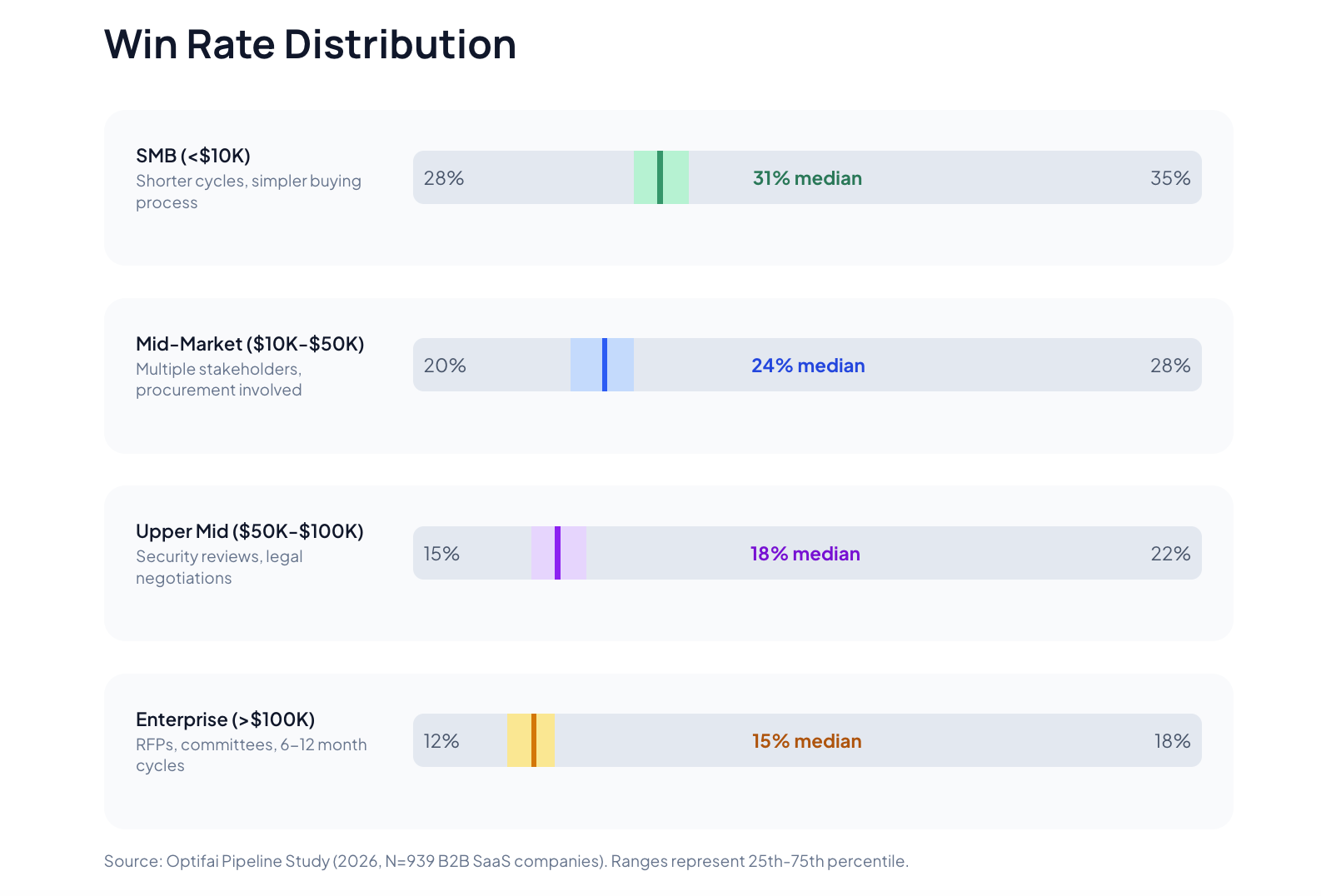
For example, a 20% win rate means you win about 20 out of every 100 closed opportunities and lose 80. That works out to roughly one win for every four losses.
Don’t treat a higher win rate as automatically better. Enterprise deals typically involve more stakeholders, longer evaluations, security reviews, and procurement, so lower win rates are common even when those deals contribute more revenue. Optifai puts a broad 20–35% win rate in its ‘healthy’ range, but your own benchmark should reflect your deal size, market, and sales motion.
Running win-loss in-house vs bringing in outside help
You can run win-loss research in-house if your team has the time, research skills, and access to buyers. Keeping it internal also ensures the interviewer has more context on your product, market, and sales process, which can help them probe the right areas.
If you need more capacity, neutrality, or specialist analysis, an external research partner is a better fit. Buyers open up more to a neutral third party, especially when the deal was lost or a competitor's involved. An outside partner also frees your team from adding interviews and analysis on top of everything else they're already doing, and brings patterns learned from running this kind of research across many companies.
Whichever route you opt for, you should choose deals deliberately, ask questions that let buyers speak in their own words, and look for patterns. When you do that consistently, you end up with recommendations sales, product, and marketing can use, plus a win rate and win-loss ratio that tell you whether those changes are working.
In the next chapter, we look at buyer perception research and how to understand what your wider market thinks about your brand, category, and competitors.



FAQs about win-loss analysis
What is win-loss analysis?
What is win-loss analysis?
Win-loss analysis is a structured research process for understanding why buyers chose your product, chose another option, or decided not to buy. You collect feedback from recent buyers and prospects, then compare responses across deals to identify recurring factors that influence buying decisions.
How long does a win-loss study take?
How long does a win-loss study take?
A single win-loss interview usually takes around 20 to 30 minutes, but the full study typically takes several weeks. You need time to select the right deals, recruit buyers, schedule interviews, analyze responses, and report the findings. Recruiting buyers—especially people from lost deals—can have the biggest impact on the timeline, because they may be less responsive than existing customers.
How many win-loss interviews do you need for reliable findings?
How many win-loss interviews do you need for reliable findings?
There’s no fixed number. You can start learning from around five interviews, but you’ll usually need more to identify recurring patterns rather than individual opinions. For a focused study, 10 to 20+ interviews can give you a more useful body of feedback, particularly if you want to compare wins and losses or different buyer segments.
What kind of ROI can I expect to see from win-loss analysis?
What kind of ROI can I expect to see from win-loss analysis?
There’s no standard ROI percentage for win-loss analysis. The return depends on what you learn and whether your team acts on it. For example, if the research leads you to change your positioning, pricing, sales process, or competitive strategy, you can track whether metrics like win rate, competitive win rate, sales cycle length, or won revenue improve afterward.
What is the win-loss factor?
What is the win-loss factor?
The win-loss factor refers to the win-loss ratio, which compares the number of deals you win directly with the number you lose:
Win-loss ratio = deals won ÷ deals lost
So, if you win 20 deals and lose 40, your ratio is 1:2—you win one deal for every two you lose. Win rate is different because it calculates wins as a percentage of all closed opportunities.
Who should be interviewed, the buyer or the internal deal team?
Who should be interviewed, the buyer or the internal deal team?
Interview the buyer for the win-loss study itself. They can tell you how they evaluated their options, what mattered most, and what ultimately shaped the decision.
Your internal team can also provide useful context. Speak with Sales before the buyer interview to understand the account, sales process, competitors involved, and what the team believes happened. Then use the buyer interview to test those assumptions.