




The State of Market Research Report
The lines around market research are blurring
Research demand is stretching resources
Demand can feel flattering. It means more people are recognizing the value of research. But when demand outpaces capacity, time, and budget, that good feeling doesn’t last. Today, researchers support more of the business and draw on more kinds of evidence to answer increasingly complex questions.
Research has trust, but not enough resources




A user researcher may now be responsible for market research, customer insights, competitive intelligence, strategy, analytics, or AI governance—sometimes all within the same role. Participants told us they had taken on an average of 4.5 new responsibilities in the past two years. That’s a lot to squeeze into one job description.
The boundaries around the role are blurring because the evidence businesses need rarely sits neatly in one discipline. A question that once called for a survey might now require customer conversations, behavioral data, market trends, and competitive context. And qualitative methods that once meant exploring the experiences of a small group in depth can now surface rich insight across hundreds of people. Connecting those signals can bring researchers closer to the decisions shaping products and businesses. The job now involves explaining where the evidence agrees or conflicts, then helping the business decide what to do with it.
Researchers are taking on more


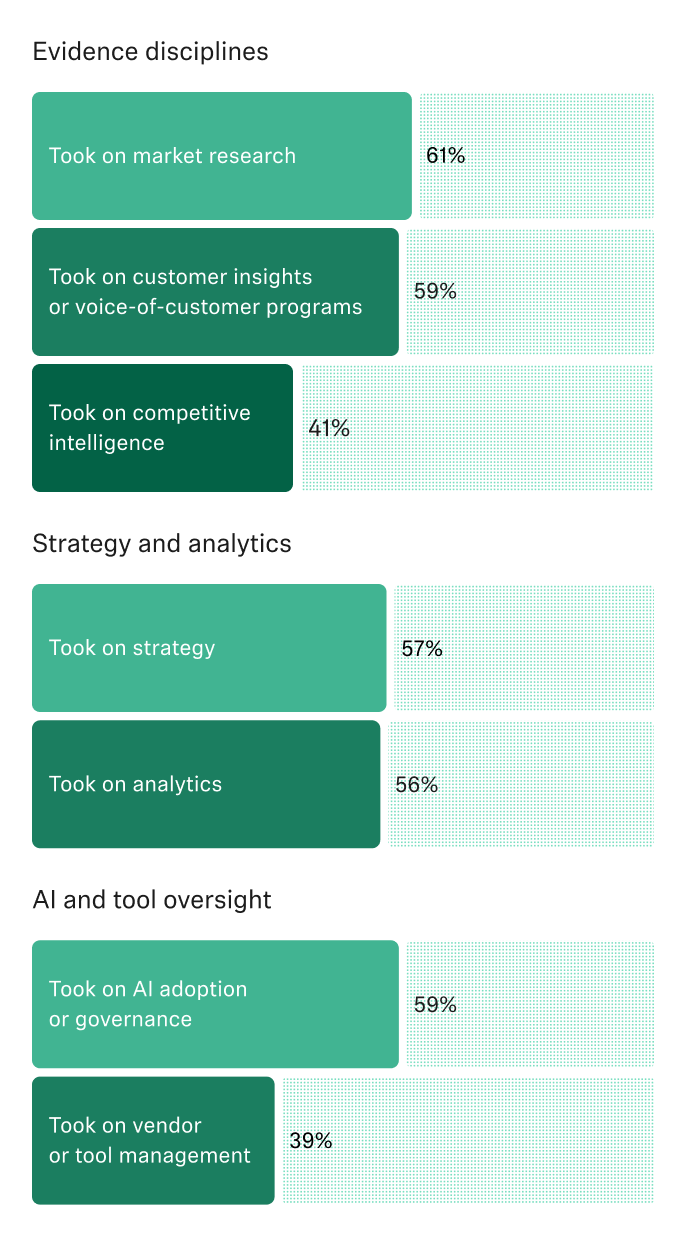


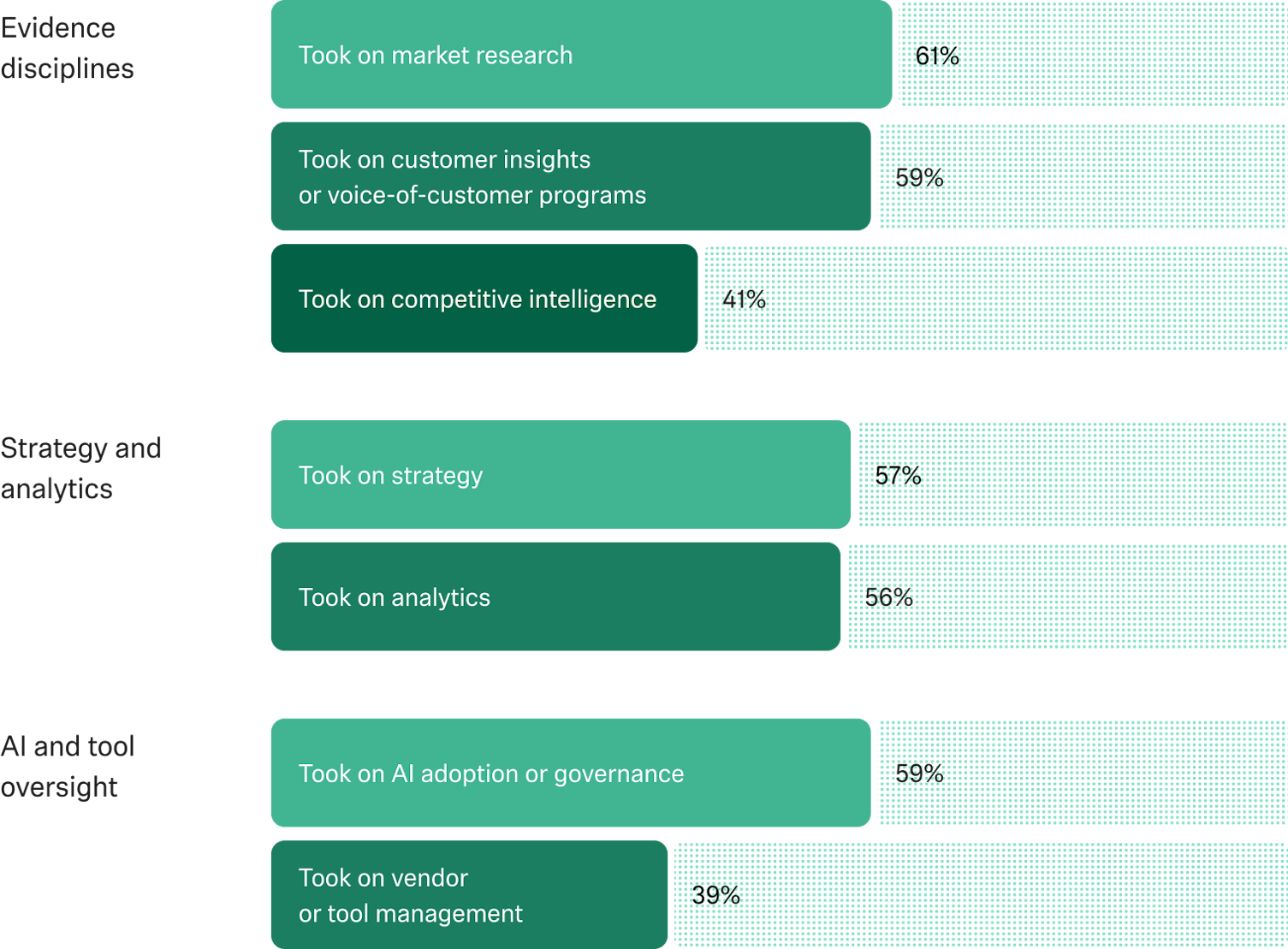
Decisions increasingly require evidence from multiple sources. A question once addressed through a survey may now require behavioral data, qualitative research, market trends, and competitive context. Researchers must synthesize these inputs, explain where they align or conflict, and what the business should do despite remaining uncertainty.
Andrea Esqueda
Marketing Researcher
The scope isn’t the only thing expanding. Over the past two years, 78% of participants said delivery-speed expectations increased, 70% saw more research requests, and 64% faced more complex projects. Meanwhile, just 30% reported increased budgets and 24% reported increased headcount. Across the measures we tracked, rising demand outpaced rising resources by 42 points.
That squeeze appears across roles and company sizes. When urgent requests keep piling up, longer-term research and follow-up work slide down the list. More gets delivered, while less learning moves forward.
AI capacity is outpacing confidence
When the research queue keeps growing and the resources don’t, extra capacity sounds pretty appealing. That’s where AI enters the chat.
Eighty-four percent of participants agreed that AI increases research capacity. Teams are using it across study planning and synthesis, as well as to make previous research easier to find. Some researchers are even working with methods and data sources that would once have required support from other teams.
AI is giving researchers more room in stretched workflows. But room to do what—and under whose rules?
AI is creating more room but outpaces structured adoption


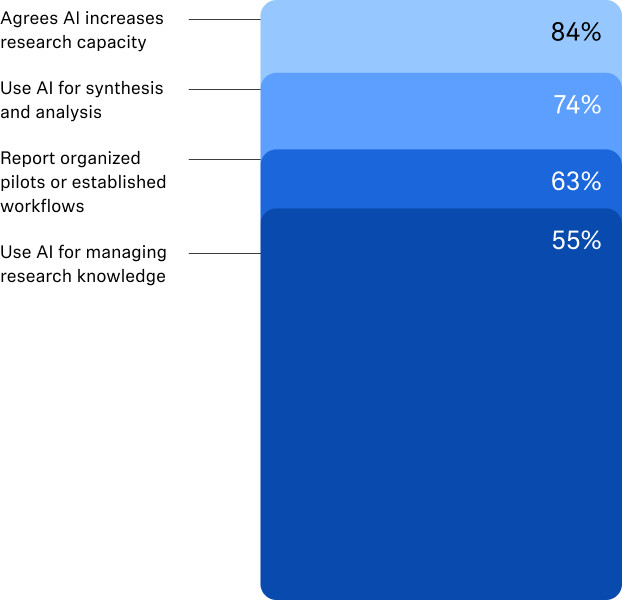


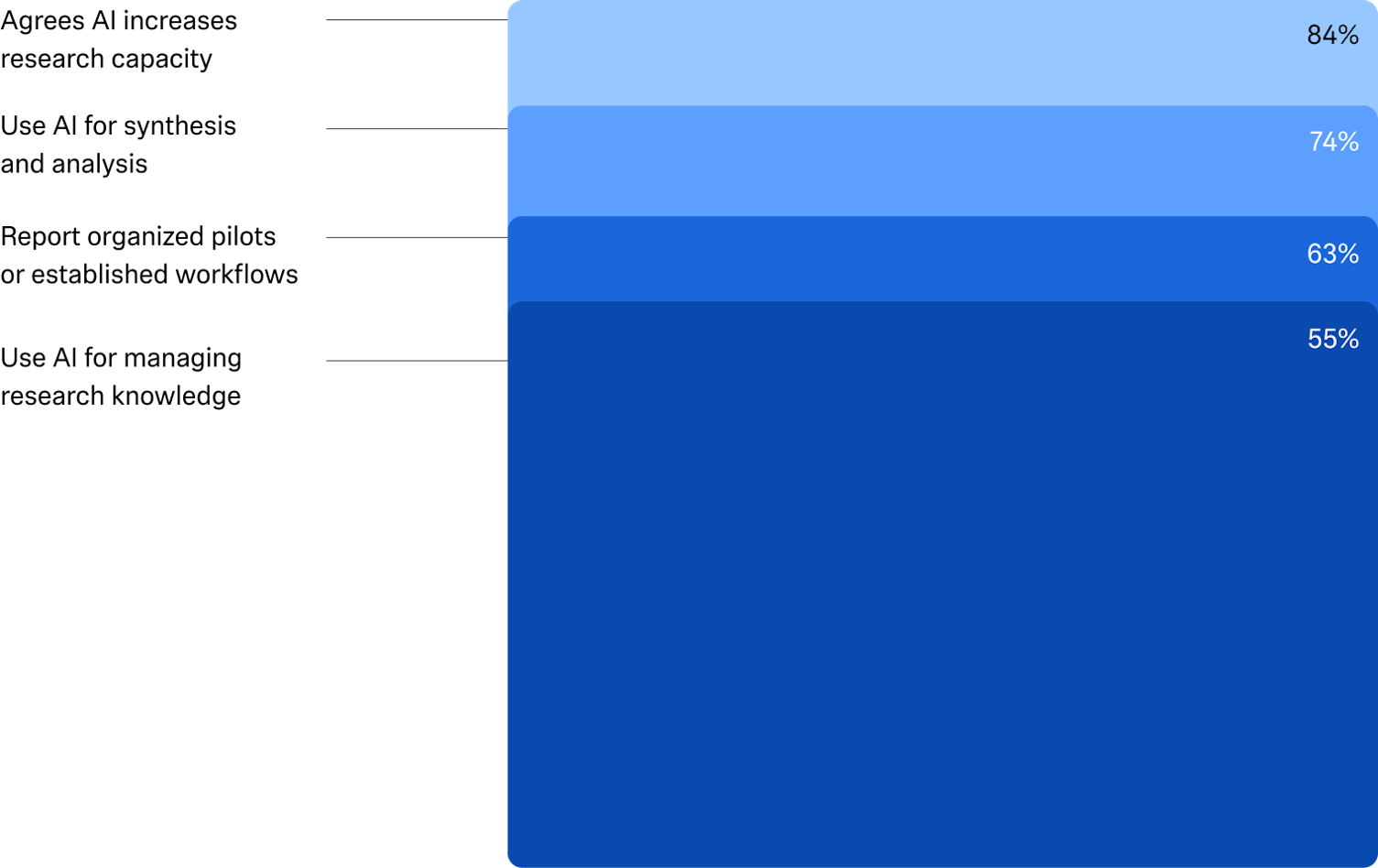
AI use is moving faster than the shared standards needed to guide it. Only 55% said their organization has clear rules for when AI can and can’t be used, and just 17% described it as integrated across the research process with clear ownership.
AI can give us a false sense of conviction. We can scour past research, behavioral data, and competitive intelligence to build a hypothesis or gut-check an idea in minutes. But speed can make new research feel like a delay.
Angie Liang
Independent Research Leader
Even among organizations with the most established AI practices, adoption varies by task. AI is widely used to support planning and make sense of findings. Teams are more selective when it begins to shape the evidence itself.
Human review remains almost universal: 96% agreed that reviewing AI-generated outputs is essential. Researchers still define the objective and decide what role AI should play. They remain responsible for judging the evidence in the context of the decision.
AI may take on more of the work, but accountability still sits with people.
Strategic influence has a decision window
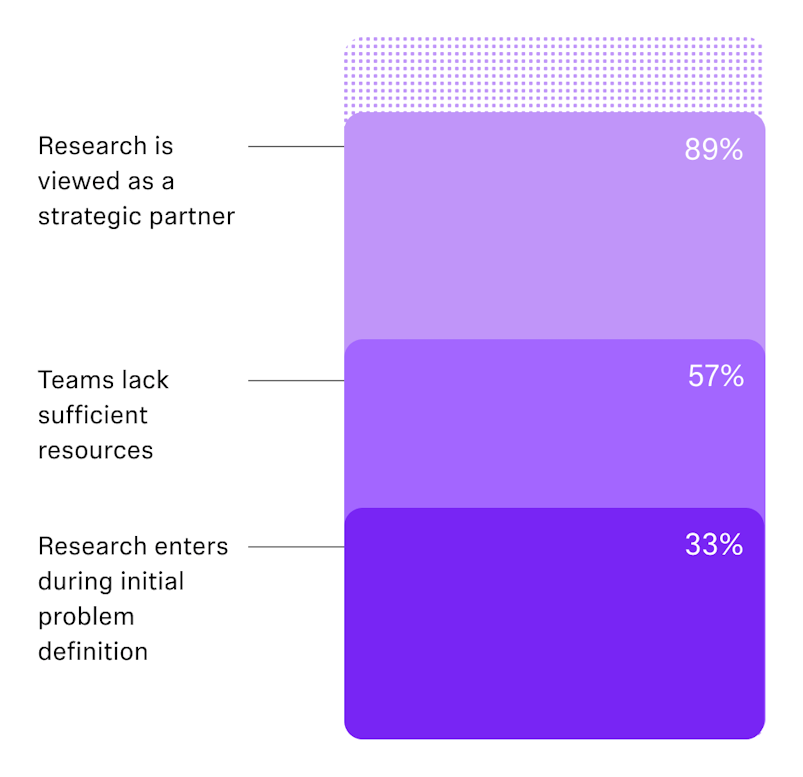
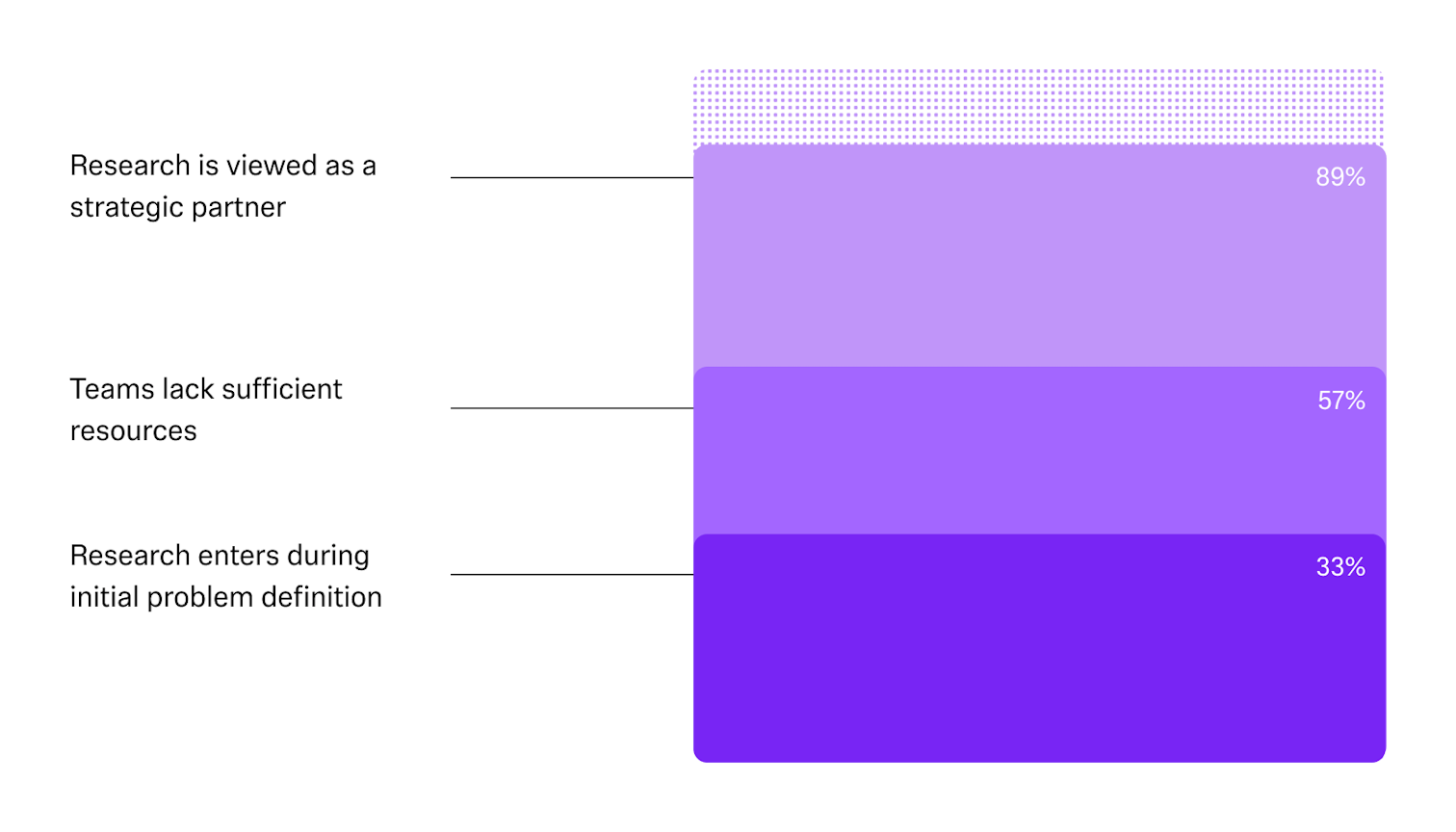
Researchers have already earned trust. Eighty-nine percent agreed that research is viewed as a strategic partner and 87% said senior leaders trust its findings. That trust only goes so far if research arrives after the decision has already been made.
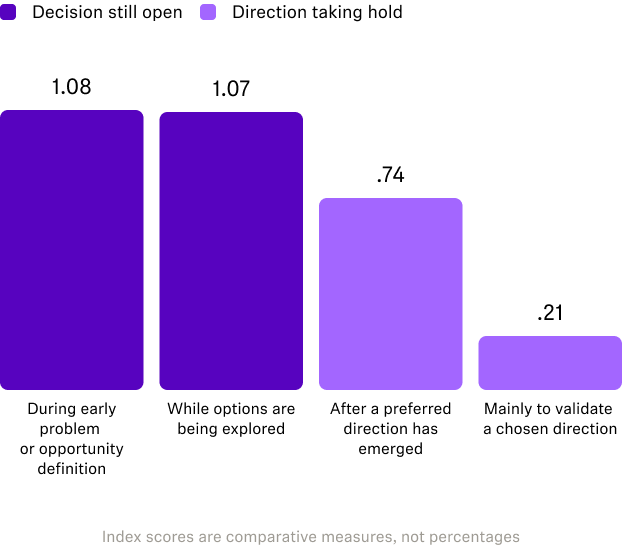
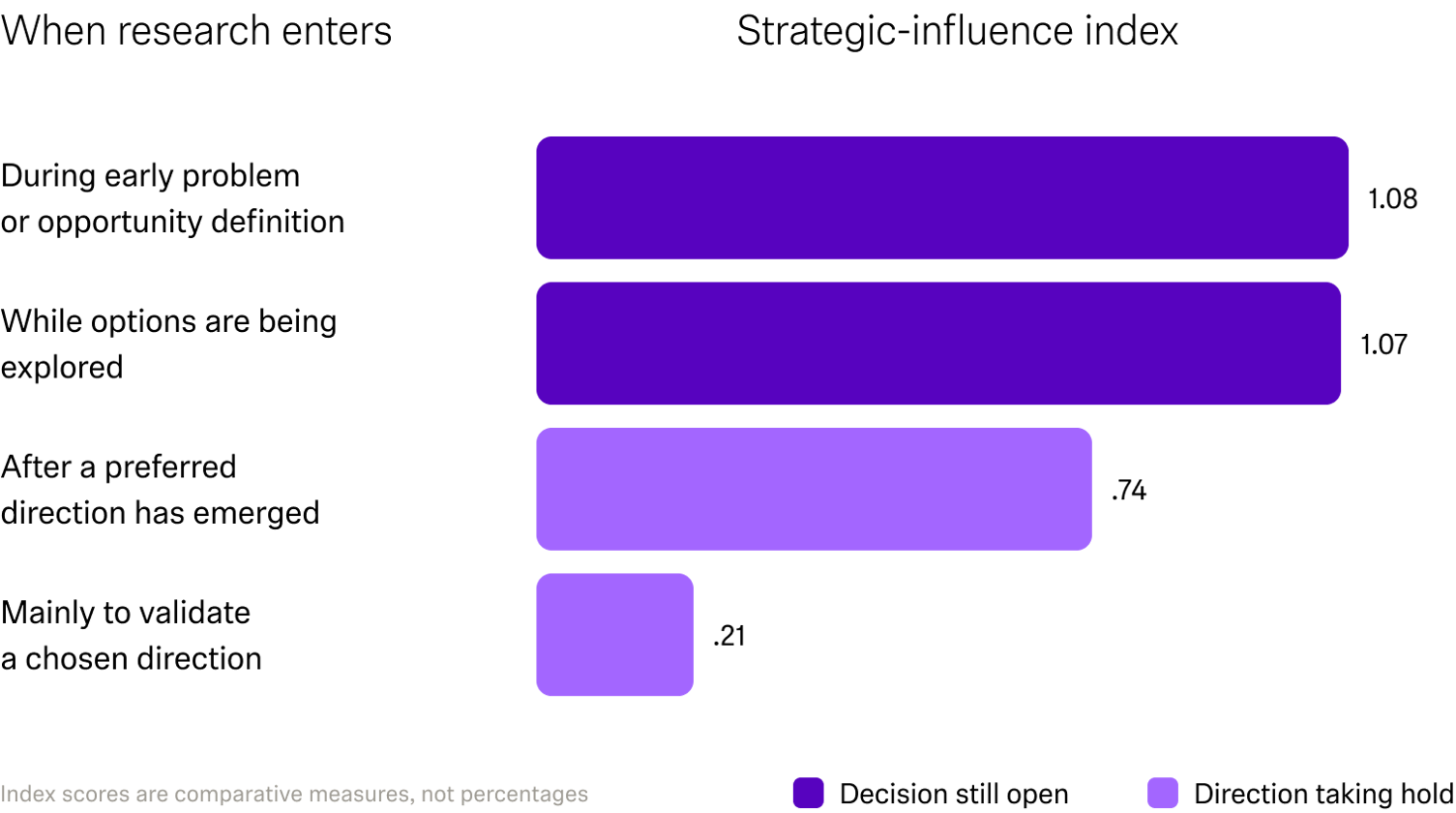
Only 33% said research usually enters while a problem or opportunity is first being defined. Another 27% said it arrives while options are being explored. Our analysis found that strategic influence remains almost unchanged across those two stages. Then it drops as soon as a preferred direction begins to take hold.
Research has the most influence before a decision and direction are set




My best research stakeholders are the ones I’ve built a personal relationship with—the folks I can grab a coffee with even without a formal agenda. That’s where I learn about projects and decisions before they’ve been formalized. I can then tweak upcoming research to answer those questions, giving me more of a seat at the table.
Theresa Manteiga
Head of Market Research
Research can arrive at the right time and still fall short if the findings don’t lead anywhere. Four in five participants said a majority of their three most recent projects informed a decision or led to action. Influence continues when researchers connect the evidence to a recommendation and stay involved as the team responds.
The learning also needs to travel. Eighty-two percent agreed that research helps their team learn over time, and 74% said findings are shared beyond the team that commissioned the work. Yet only 68% agreed that people across the organization can access and use previous research. Usable research needs context. People have to know whether an insight still applies and when the decision calls for new evidence.
Alyssa Domash
Independent Market Researcher
The learning also needs to travel. Eighty-two percent agreed that research helps their team learn over time, and 74% said findings are shared beyond the team that commissioned the work. Yet only 68% agreed that people across the organization can access and use previous research.
Usable research needs context. People have to know whether an insight still applies and when the decision calls for new evidence.
The next decision shouldn’t start from scratch
To influence decisions, research has to move at the pace of working teams and show up when answers are needed—not two or three weeks later. Researchers also need to stay close to the relevant business workstreams. Otherwise, insights may be obvious, redundant with past work, or irrelevant to the most pressing decisions.
Hugh Lagrotteria
Staff Market Researcher
Research has earned credibility. Turning that trust into consistent influence depends on whether it reaches decisions in time and remains useful beyond the original project.
Research doesn’t have to be in the first meeting, but it does need to arrive before the answer is set. That won’t always require a new study. When previous research is easy to find and use, teams can bring what they already know into open decisions and focus new research on the remaining gaps.
As the boundaries between research disciplines blur, researchers are working across a wider mix of customer, market, product, and competitive evidence. AI can make that evidence easier to navigate, while researchers provide the context and judgment needed to use it well.
A system of learning connects that knowledge with the decisions being made today. Each study can shape the decision at hand and give the next one a stronger starting point.
What this means for market research today
What is role convergence in market research?
What is role convergence in market research?
Role convergence is the growing overlap between research disciplines and work that once sat in separate teams. Researchers are increasingly combining those responsibilities and forms of evidence. In our survey, participants reported taking on an average of 4.5 new responsibilities in the past two years.
What are the biggest trends for market research in 2026?
What are the biggest trends for market research in 2026?
The State of Market Research Report follows growing demand as it stretches already-limited resources. It also looks at how AI is adding capacity before many organizations have settled questions around confidence and governance. Across both trends, timing shapes how much influence research has on a decision.
How is AI changing market research?
How is AI changing market research?
AI is helping researchers plan studies, make sense of evidence, and bring previous learning into new work. It can also open up methods that were previously out of reach. Adoption varies by task, so teams need clear ownership and the right level of human review for the decision.
Is AI replacing market researchers?
Is AI replacing market researchers?
The findings in the report point to a changing role for market researchers. AI can take on more of the execution, while researchers remain responsible for the question being asked and the quality of the evidence. Their judgment connects the findings to the decision.
How can market research become more strategic?
How can market research become more strategic?
Research has more room to influence a decision before a preferred direction takes hold. That influence continues when findings lead to a clear recommendation and what the team learns remains useful after the project ends.
What is a system of learning?
What is a system of learning?
A system of learning is an ongoing approach to connecting what an organization knows with the decisions it is making. It establishes a shared understanding, monitors change, surfaces important questions, brings in research while choices remain open, and feeds each new learning into the decisions that follow.
Methodology
The State of Market Research survey was created using Maze and distributed between August 3 and August 17, 2026. Maze collected 200+ responses from professionals actively involved in market research, including marketing or digital marketing (20%), market research (19%), business or corporate strategy (17%), UX research (13%), and more. Participants spanned seniority and organizations of all sizes, with strong representation from North America (69%) and Europe (18%).
Contributor perspectives featured throughout the report reflect the individuals’ own views and responses to the research findings. Their inclusion should not be interpreted as indicating any customer or partner relationship with Maze, or as an endorsement by the individuals or their employers.
About Maze
Maze empowers researchers to be change makers, turning customer insights into a system of learning that compounds into enduring competitive advantage. By bringing recruiting, testing, and analysis together, Maze helps organizations move beyond one-off studies to a shared, connected foundation of evidence. From researchers to designers and PMs, anyone can run studies that answer any question and drive better strategy. Equipped with Maze’s research-grade AI, teams can focus on what matters most: understanding people, connecting what they already know with their biggest decisions, and shaping change with confidence.
There's more in the data
Go deeper into the trends reshaping market research—and discover how broader roles, connected evidence, and learning create a smarter starting point for every decision.