













TL;DR
User research is becoming the engine of modern product development and business strategy. In 2024, we saw increased demand for research, more teams across the organization (from Design and Product to Marketing and Leadership) relying on insights to make decisions, and AI-powered capabilities beginning to support the research process.
Now, in 2026, those trends have intensified. Across the UX industry, the role of research is expanding. Rather than simply running studies, UX professionals are building systems that help teams learn continuously and improve digital experiences at scale.
In this article, we cover the major trends identified in our 2024 Future of User Research Report—as well as whether they still hold true in 2026 based on the findings from our most recent report.
Read on for a snapshot of how the research space has evolved since 2024, and check out the 2026 Future of Research Report to get up-to-date insights on the current state of user research.
As technology enables innovation and removes barriers to product development, a company’s ability to build products is no longer a differentiating factor. Instead, companies must continuously adapt to their users’ changing needs and build the right product faster than competitors.
The secret to achieving this? User research.
Learning from users every step of the way is critical to discovering actionable insights that fuel continuous innovation, confident decision-making, and business success.
To better understand how product teams conduct research and how the role of the user researcher is evolving, Maze surveyed over 1,200 product professionals and interviewed UX leaders at Miro, Wise, Twilio, and more.
Keep reading for an overview of the key findings from The Future of User Research Report 2024 and discover the three macro trends that will shape the industry in 2024 and beyond—plus a brief look at how these trends are playing out in 2026 based on our latest report.


75% of teams look to scale research as demand grows
62% of respondents report that the demand for user research has increased over the last 12 months. This increase could be influenced by industry trends like continuous product discovery and research democratization across teams. At the same time, organizations are operating under significant uncertainty, making them more risk-averse. This has led to a greater emphasis on understanding customer needs to create products and solutions that can truly move the needle.
Roberta Dombrowski, Research Partner at Maze, shares, “Businesses are trying to put themselves in a position to stay afloat given the midst of changes over the last few years. Research can be a key value driver in making sure that's happening. It can help mitigate risk and clarify the strategy of the business, product, and services.”
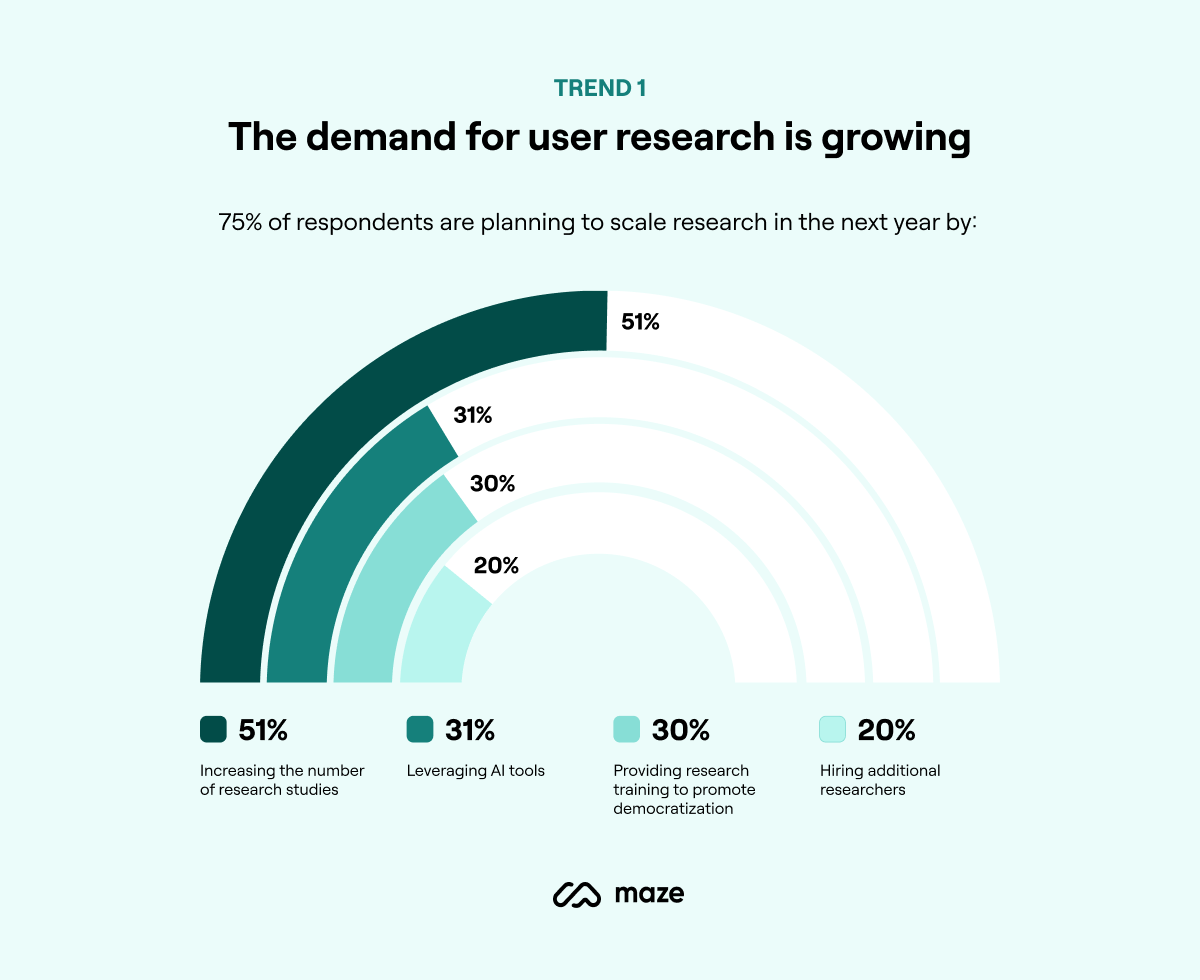
To address the growing appetite for user insights, 75% of respondents plan to scale research by increasing the number of research studies (51%), leveraging AI tools (31%), and providing training to promote democratization (30%).

By leaning on new technologies, like AI, and enabling more teams to engage in research, product teams are focusing on sustainable methods of expanding their research programs.
📌 Takeaway: User research helps companies navigate change
The role of user research is more critical than ever to successfully navigate change. By empowering the organization to connect with users and understand their needs, user research offers a strategic foundation upon which to make decisions, mitigate risk, and set a clear direction for your business and product.
2026 Update: Is this still true?
Yes, and it’s intensified. In 2026, two‑thirds of participants (66%) say demand for user research has increased in the past 12 months. This confirms that the push to scale research is a sustained shift.
At the same time, nearly seven in ten teams (69%) now use AI in at least some research projects, showing that this increased demand is being met through AI‑enabled workflows rather than adding more headcount.
Together, these trends suggest that what was emerging in 2024—rising demand and plans to scale research—has become the normal day‑to‑day reality for research teams in 2026.
Research democratization fosters a culture of learning and empowers decision-making
The report shows that the entire organization relies on research to inform decision-making. Design (86%) and product (83%) are the main consumers of research. This is followed by marketing (35%), executive teams (27%), and engineering (27%).
Moreover, companies are scaling the impact of research by empowering different teams throughout the organization to conduct research and gather the insights they need to confidently make decisions.
In addition to researchers, respondents report that product designers (61%), product managers (38%), and marketers (17%) conduct research at their companies.
The key benefit to growing research practices is that an organization will grow a research mindset in tandem. Not only will external benefits like competitive advantage come into play, but employees inside the organization will also better understand how and why important business decisions are made, resulting in more transparency from leadership and a happier and more thriving work culture for everyone.


Janelle Ward
Founder of Janelle Ward Insights
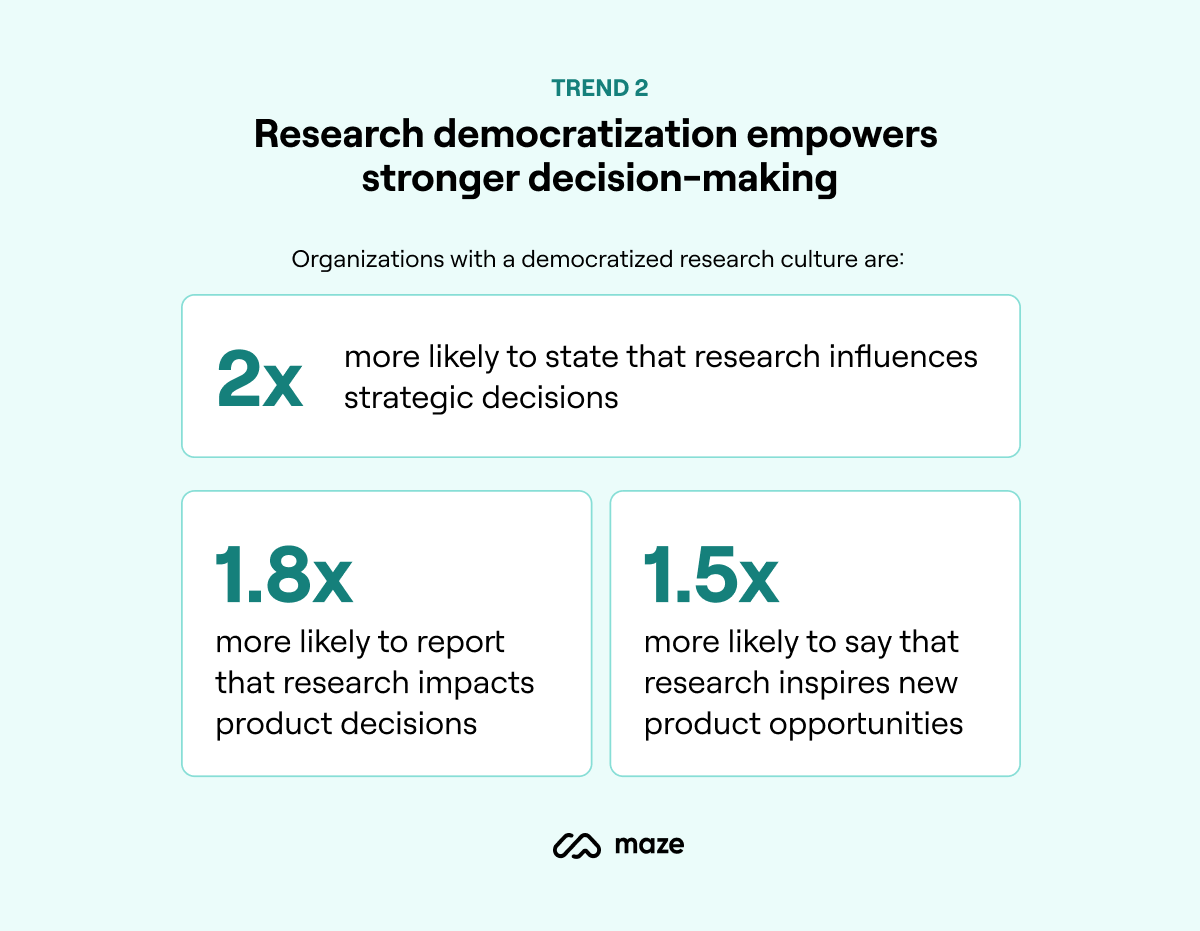
As teams grow this research mindset through democratization, they benefit from a greater impact on decision-making. Indeed, teams that have embraced a democratized research culture are 2x more likely to report that user research influences strategic decisions, 1.8x more likely to state it impacts product decisions, and 1.5x more likely to express that it inspires new product opportunities.

When adopting a culture of research democratization, it’s important to remember that not everyone can conduct every type of research.
While research democratization is associated with benefits like improved decision-making and enhanced collaboration, ensuring data quality and accuracy remains one of the key challenges.
To guarantee that research maintains high quality in practices and outcomes, the role of the user researcher is transitioning into that of an educator, enabling different teams to responsibly and effectively collect the user insights they need.
For best practices on how to scale research for your organization, explore Maze’s UX Leadership Playbook: Democratizing Research to Deliver Impact at Scale.
📌 Takeaway: Researchers can make research available across all corners of the organization
UX researchers can foster a culture of learning at their organizations by training other teams on research best practices and by focusing on more foundational, strategic projects. With their expertise and empowered by specialized tools like Maze, researchers can take the reins to make research available within every team in the organization.
2026 Update: Is this still true?
In 2026, research is considered essential to all levels of business strategy and operations in 22% of organizations.
At the same time, more roles are involved in research, which increases both its reach and its exposure to specific risks like inconsistent methods, poor data quality, and duplicated or conflicting insights when work is not coordinated.
Product managers (39%), market researchers (35%), and marketers (23%) are all running studies alongside dedicated research teams.
With 69% of teams now using AI in at least some research projects, the researcher’s role as educator and systems‑builder becomes even more critical in 2026 to set standards, review studies, and ensure findings are trustworthy enough to drive decisions.
AI enables product teams to scale research and focus on strategic initiatives
Artificial Intelligence (AI) is transforming how we build products and conduct user research.
According to the report, 44% of product teams leverage AI tools to conduct research—with 35% using AI in some research projects and 9% using AI in most research studies. An additional 41% are not currently using AI but would like to adopt it in the future.
In particular, AI is taking over the tactical aspects of research at each stage of the product development journey, removing manual, repetitive tasks from researchers’ workloads. Respondents reported using AI tools for analyzing user research data (62%), transcription (54%), generating research questions (48%), and synthesis and reporting (45%).
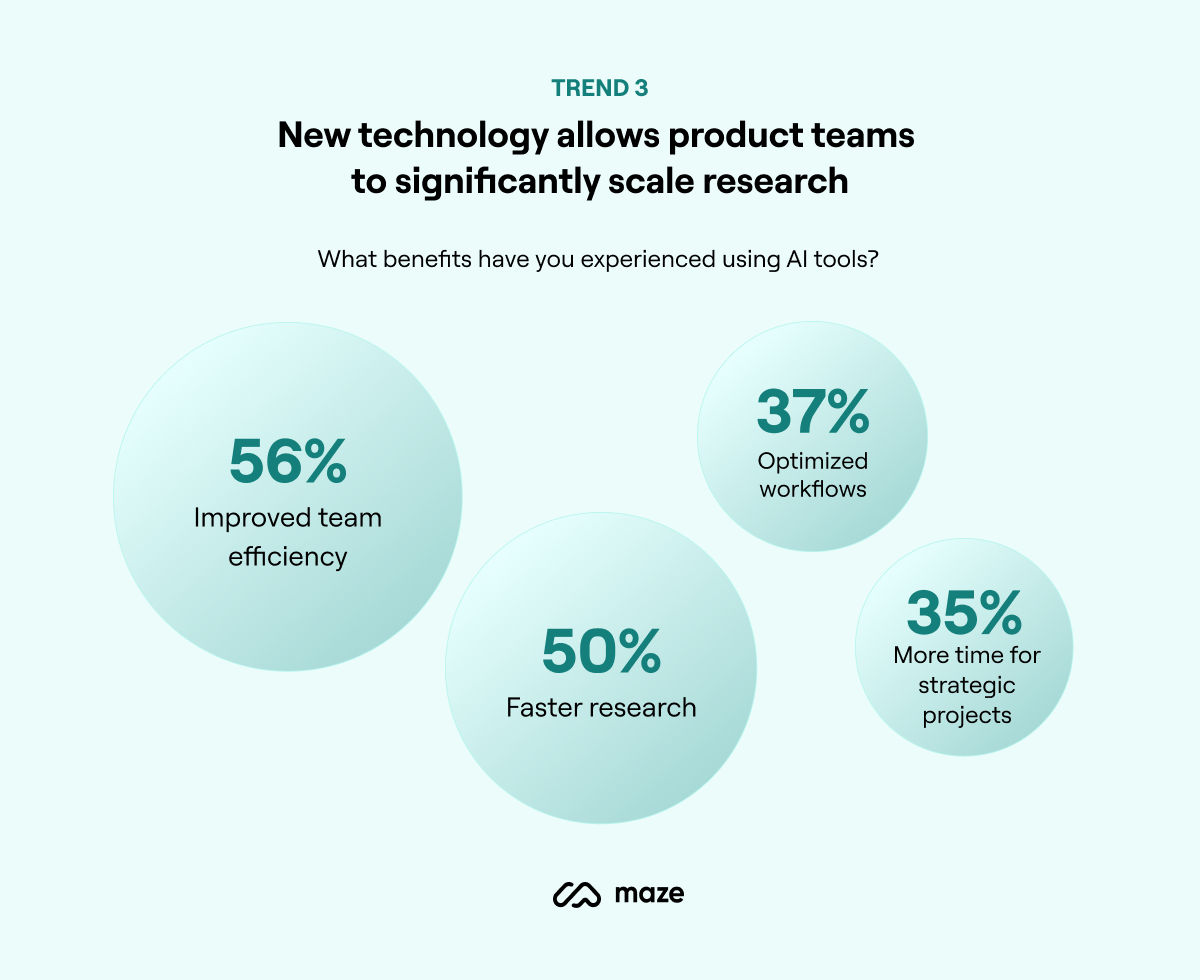
When we asked the survey audience about the benefits they experienced using AI tools, respondents shared that AI improves team efficiency (56%), allows teams to conduct research more quickly (50%), optimizes workflows (37%), and provides respondents with more time to focus on strategic user research projects (35%).

With these benefits in mind, it’s no surprise that 31% of respondents are planning to leverage AI to scale research next year. AI minimizes time-consuming tasks, allowing researchers to work more efficiently and spend additional time on projects that have a greater impact on the organization.
Interested in AI research tools?
Respondents who use Maze AI reported even greater benefits, with 62% improving team efficiency, 56% increasing research speed, and 41% optimizing workflows. Learn more about Maze AI.
While AI can be a powerful tool to augment research capabilities and efficiency, it’s not changing the indisputable value of research: an intimate and continuous understanding of users and their needs. And it’s not taking the place of the researcher.
“We need to have a point of view as researchers if we want to show up in conversations that can impact the rest of the business. Without the full context, AI can't make the same connections as we can," says Dalia El-Shimy, Director of UX Research at Wise. "If you're not sitting with your data and, instead, having AI write on your behalf, you aren't spending the time creating that point of view, with the risks of losing the thing that makes research truly interesting."
📌 Takeaway: AI opens the door for researchers to embrace a strategic role
With AI tools at their disposal, researchers have the opportunity to focus their efforts on more impactful research projects that help answer key questions about what to build, who to target, and how to win as a business. By connecting user insights with opportunities for competitive advantage, user researchers gain a seat at the business table.
2026 Update: Is this still true?
Yes, AI is continuing to enable faster research. In 2026, 69% of teams now use AI in at least some research projects, and they’re seeing:
- Faster turnaround on research (63%)
- Improved team efficiency (60%)
- More optimized workflows (56%)
In fact, 40% of organizations say AI frees up time for more strategic work.
At the same time, researchers agree that AI has not replaced their judgment. They see human involvement as essential for:
- Interpreting nuance and emotion (82%)
- Making ethical decisions (80%)
- Framing the right questions (76%)
- Turning findings into strategic recommendations (66%)
This shows that in 2026, AI is very clearly enabling teams to scale research, while researchers keep human judgment at the center of how insights are interpreted and applied.
Exploring the future of user research
From guiding teams to conduct their own user research to identifying competitive solutions, the role of the user researcher is expanding into a strategic figure for the organization.
"The surfacing and socialization of knowledge are crucial to innovation," highlights Emma Craig, Head of UX Research at Miro." Researchers are best positioned to pluck out, transform, and turn siloed expertise into shared knowledge that informs every decision."
Research democratization and AI tools will further solidify user researchers as strategic partners by giving them the time to focus on complex projects and allowing them to socialize the value of research to all corners of the organization.