

















TL;DR
UX research democratization is the process of empowering anyone in your organization to conduct user research—not just dedicated researchers. It involves making UX research tools, processes, and insights accessible to everyone across your organization. Ultimately, it expands who conducts and uses the insights from UX research.
When done right, it speeds up time to insights, scales research capacity without proportional headcount, and builds a truly user-centered culture. But without proper training, clear roles, and quality guardrails, you risk unreliable insights and wasted effort.
By democratizing user research, you empower teams at your organization to ground their every move in real user insights. Instead of having a single designated team making user-centered decisions, you open the door to a customer-centric culture company-wide.
In this article, you’ll learn what UX research democratization is, along with the benefits and challenges that come with it. Then, we’ll take you through the steps to democratizing research in your organization.
What is UX research democratization?
UX research democratization involves enabling more colleagues across your organization to conduct and access user research. Instead of research existing in a silo, democratization empowers teams to gather user feedback and apply it to their workflows, regardless of role.
UX research democratization doesn’t mean everyone in your organization turns into a researcher. Instead, it provides them with the tools and knowledge to get insights when necessary.
With the what covered, here’s the why.
Benefits of user research democratization
The democratization of user research is fast becoming a priority for Product, Design, and Research teams because it helps root more decisions in real user feedback.
Because more people are doing and using research, insights become increasingly easier and faster to gather, and more widespread in their application.
Here are some of the main benefits research democratization can bring to your organization:
- More insights, faster: When more people can run a quick usability test or survey, you’re not waiting for your researcher’s schedules to open up. Instead, teams can move forward, getting insights and making key decisions and product changes faster.
- Reduced pressure on dedicated researchers: When smaller tests can be handled by non-researchers as and when they’re required, it frees up time for dedicated researchers to focus on bigger studies. Instead of running surveys for Marketing, researchers are able to conduct research that informs the bigger picture.
- Stronger decision-making: With more people conducting research and accessing insights, more decisions can be routed in real customer wants and needs. Research informs business decisions and plays a key role in decisions company-wide.
- Creating a user-centric culture: As user research seeps across every part of your organization—from Sales to Marketing—your people will understand the value of research and grounding decisions in real user feedback. They’ll also have the tools and knowledge to apply research where they see fit.
Although research democratization clearly helps organizations gain insights faster, it also comes with considerable challenges.
Challenges and risks that come with research democratization
Democratizing research can be tricky and requires teams to overcome some roadblocks:
- Research quality problems: Without proper training, novice researchers and teams can make mistakes during their research or analysis, leading to inaccurate insights.
- Bias affecting insights: A non-researcher might ask leading questions or fall victim to confirmation bias, as they haven’t spent years perfecting the art of not doing so. This means insights can become unusable because they’re biased.
- Pressure placed on research teams: The task of guiding and supporting non-researchers and evangelizing user research falls on UX research teams. If they’re already resource-stretched, the additional responsibility makes the time-to-insights longer.
- Inaccessible insights: If your organization doesn’t have a standardized way to manage insights, democratization can quickly fail. Teams need to know where to store and access insights in order to use them effectively.
- Ethical issues: Non-researchers that aren’t effectively trained may inadvertently violate privacy and ethics laws and best practices. This puts your organization at risk, as well as the participants involved in the studies.
- Cultural resistance: You can lead a horse to water, but you can’t make it drink. Wanting research democratization doesn’t mean you’ll get it; prepare for some resistance to change from across your organization.
Before you gain the benefits of democratization, you’ll need to determine whether your organization is ready to roll out this company-wide initiative. We’re explaining how in the next section.
Levels of democratization: A maturity model
UX research democratization might seem daunting. It’s certainly not an initiative your organization can adopt overnight.
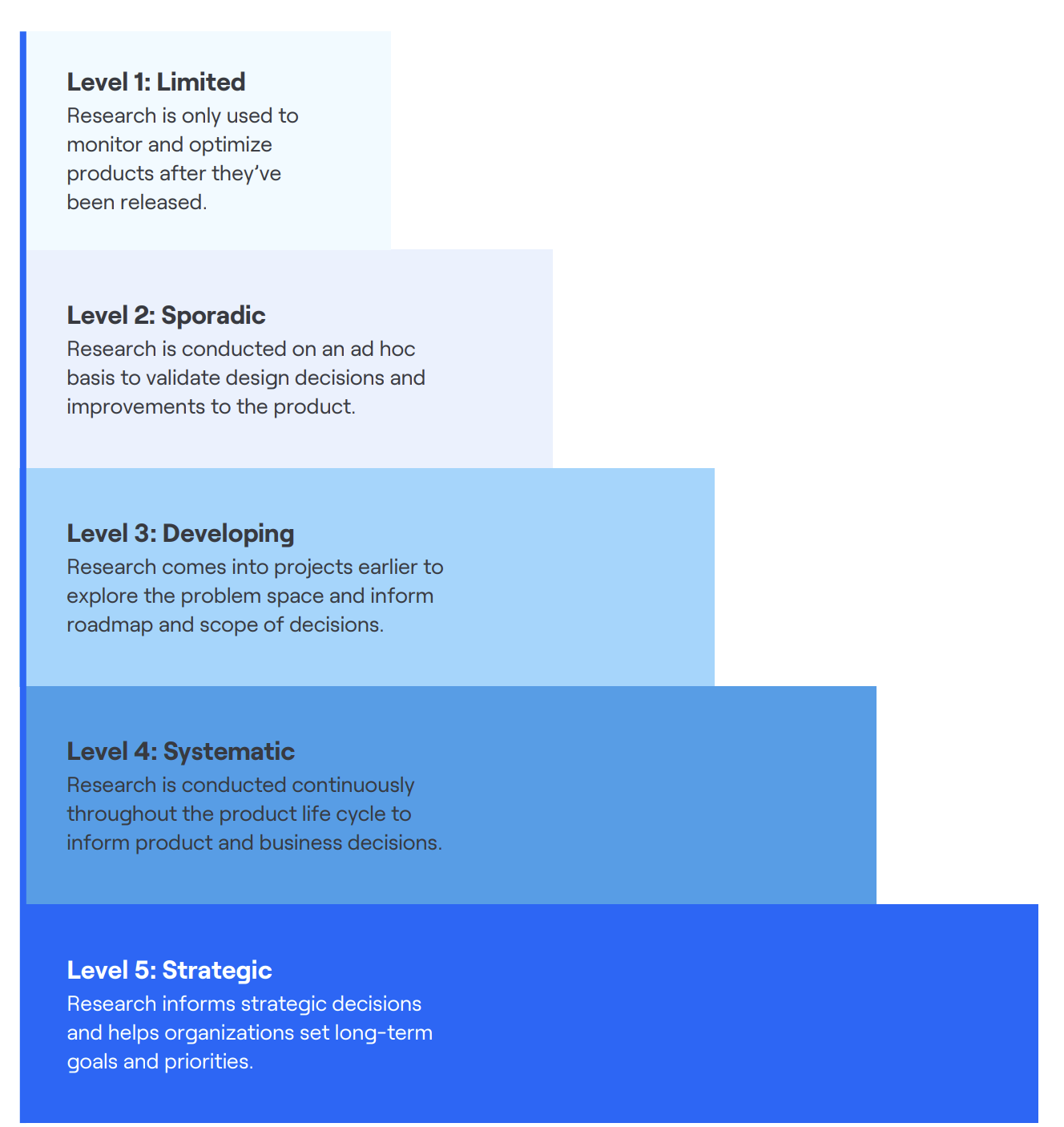
Success depends on identifying your current research maturity level, as this dictates how far you have left to reach true research democratization. Use Maze’s research maturity model to help understand the five stages of research maturity:
- Limited: Research is used to monitor and optimize post-launch
- Sporadic: Research is used on an ad hoc basis to validate design decisions and product improvements
- Developing: Research comes in earlier, often to explore the problem space and inform roadmap decisions
- Systematic: Research is conducted continuously throughout the product's lifecycle to inform product and business decisions
- Strategic: Research is used to inform strategic business decisions and set long-term priorities

1. Limited
In the earliest phase of UX research maturity, you use research only to monitor and optimize products after release. User research exists, but it’s more of an afterthought.
Usually, insights come only from passive sources such as analytics, customer support, and product feedback.
Leaders aren’t yet aware of the benefits user research brings, so there’s little incentive for specialized teams, let alone bringing UX research to the entire organization.
As such, user research is exclusively reactive, serving to slightly improve product usability and reduce support requests.
Only when team members collect data before the product launch can they move to the second stage.
2. Sporadic
The sporadic maturity level involves teams conducting ad hoc research to test existing products and validate new solutions. They collect data to validate design decisions, as executives partially understand research benefits—but there’s little incentive to go beyond design validation.
There probably aren’t any dedicated UX researchers yet. It’s likely that people from Design and Product teams are championing user research through methods such as usability testing, prototype testing, and user interviews.
At this point, there’s no process for collecting and sharing insights across the entire organization. Insights exist, but they don’t get the consideration necessary to ground your entire product in user feedback.
As organizations progress to the next stage, they need to incorporate more research and champion cross-functional research practices. UX research evangelization becomes an important part of making user research more central to product development.
3. Developing
In the developing research maturity stage, research has two primary functions: discovery and delivery. These ‘dual-tracks’ inform each other. Teams conduct user research early in product development to understand user needs and problems—and to inform product design while iterating on user feedback.
This is also the point where your organization starts hiring dedicated researchers, as leadership fully understands how user feedback helps deliver better products. And while frameworks do exist, they’re likely only used by the research team.
This is also where user research begins to impact business metrics such as customer satisfaction, engagement, and adoption. Getting to the next level is all about building processes that strengthen user research. This involves standardizing a roadmap, helping you to gain insights more consistently.
4. Systematic
Consider yourself in the systematic maturity level when there’s company-wide buy-in for user research. A dedicated research team not only conducts research, but also focuses on building frameworks for conducting studies and sharing findings across the entire organization.
At this point, your organization is likely using a variety of tools and methods to collect user insights across the product lifecycle. A dedicated UX research team is conducting research to explore potential solutions, inform product direction, and sometimes even inform business decisions. Research is understood. It’s also supported and valued, ultimately informing your company’s direction.
The demand for insights is growing. You need to scale and embed research across your organization and make user insight truly insight-led. Combining research with strategy holds the key to your final maturity level.
5. Strategic
User research is now at the top level of your organization. There’s full buy-in, so research also helps explore new opportunities. It informs strategy, direction, and vision. Processes have been in place for quite some time, and your team has no trouble following them to gain insights.
The key marker of strategic maturity is full democratization. Your UX research team gives training and education programs so others can conduct and utilize insights as well. And while dedicated research roles are clearly defined—others are encouraged and empowered to conduct research as well.
Since user research is so baked into your entire organization, it becomes an indispensable strategy for decision-making and meeting business objectives. You’re also implementing initiatives to meet future UX research goals.
You’re achieving business objectives with research-informed decisions across the organization, and you’re also leaps ahead of other companies thanks to a research-enabled competitive edge.
How AI accelerates democratization
User democratization can be easier to implement with artificial intelligence. By adopting it into your workflow, phases like testing design or data synthesis become easier for non-researchers.
For example, AI helps you analyze qualitative data from user interviews without hours of review. Instead of wading through transcripts, you can quickly identify patterns and overarching themes. This enables novice researchers to get stuck in immediately.

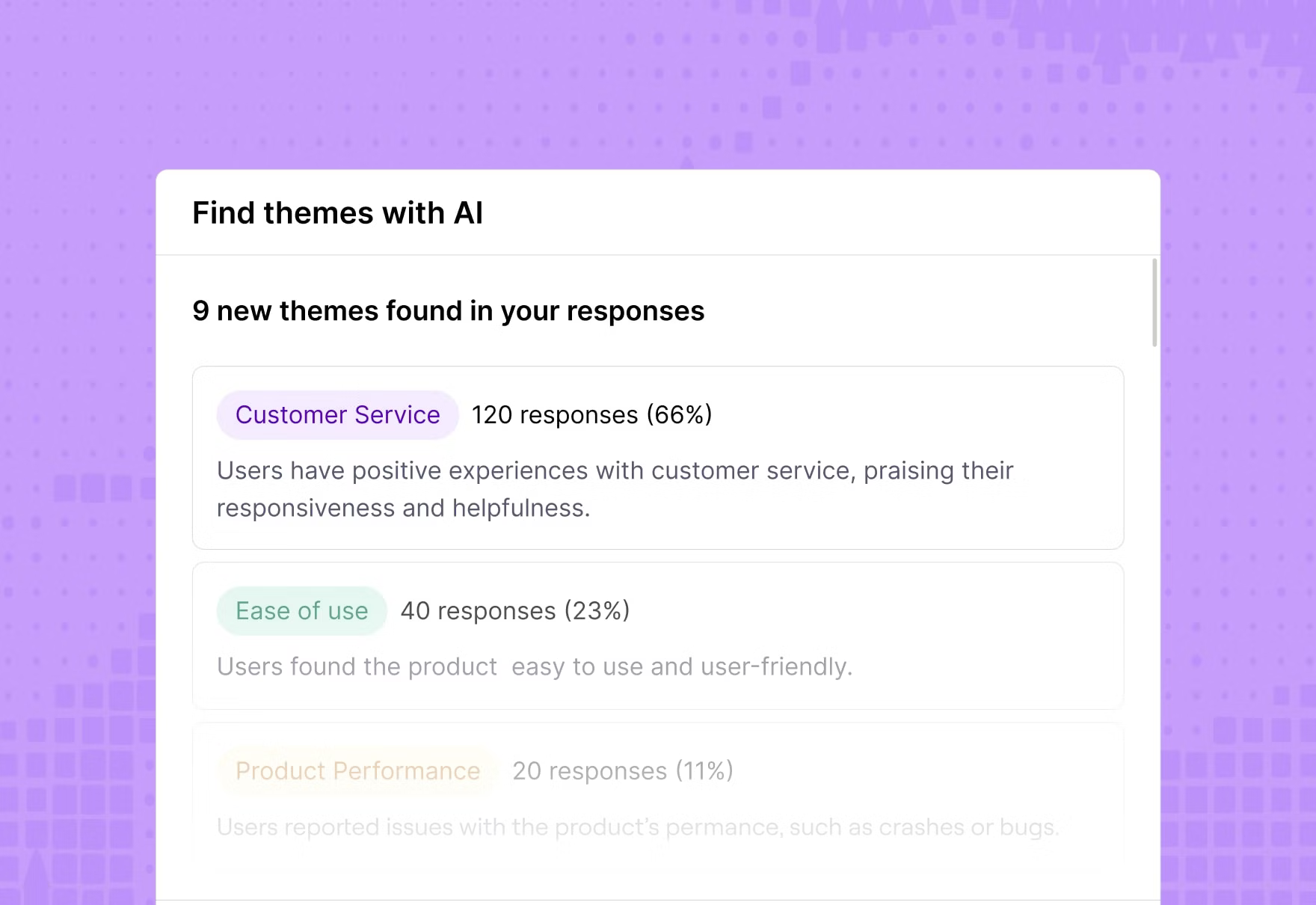
Plus, it’s not just analysis that AI can support. AI moderators are increasingly popular with researchers and non-researchers alike. They enable teams to conduct studies without throwing them into the interviewing deep end. Interviewing is a skill that not all people have. AI moderation also saves time, as teams can run interviews automatically and concurrently.


Another way AI can help is by supporting with research questions—specifically ensuring they’re not biased or leading. For example, Maze’s AI-powered tool, Perfect Question, provides rephrasing suggestions and support to ensure research questions in surveys and tasks don’t lead to biased insights.


Of course, UX researchers are still absolutely necessary in guiding research. AI supports democratization, but user research is and will always be human-centered.
💡Maze supports research democratization with a wide range of AI functionalities. Check out how Maze AI can support your path to true democratization.
How to democratize research successfully: Step-by-step
Having an internal, dedicated UX research team is one thing. Shipping that skillset to your entire organization and empowering them to do user research is another. For non-researchers, a slow, structured approach is best.
Using a framework provides organizations with a path to rollout. Here are the five steps to make democratization smooth.
1. Gauge research demand and needs
Start by looking at your organization’s user research needs. Take note of your completed projects as well. Categorize projects into reactive research—such as immediate usability issues—and strategic UX research—such as product discovery.
Ask yourself:
- Where are our workflows lacking?
- Where can we benefit from more user research?
- What skills would non-researchers need to fulfill these gaps?
Note your findings and present them to stakeholders. Once you have the green light, it’s time to evangelize UX research across your organization.
2. Identify existing researchers and people who want to do user research
This phase focuses on identifying the people who can fill your previously noted research gaps. Your core team, of course, will be your dedicated UX researchers.
Once you’ve noted them and their responsibilities down, find other people in your organization who are available, meaning three things:
- They’d benefit from user research insights
- They are willing to conduct user research
- Have enough bandwidth to do user research
This is also when you can assess any present skills and knowledge. Once you find people who want to do research, ask them a few informal questions about their knowledge and skill set. It’ll help you design curriculum and guidance during the next phase.
3. Guide new people with the help of professional researchers
You know your organization’s UX research needs, and you’ve got the cross-team and organizational buy-in to achieve them. Now bridge the skill gap. For this phase, you’ll need at least one dedicated UX researcher to guide new PwDRs so they can conduct and analyze research.
Consider using self-paced learning resources, a dedicated course, or even having team members shadow user researchers. Establishing a regular feedback loop will also encourage consistent learning. Think regular check-ins and a dedicated Slack channel for user research.
A user-friendly UX research tool is especially helpful in this phase. Use an easy-to-use platform with intuitive testing design, analysis support, and clear reporting to make learning easier. For example, a tool like Maze has automatic reporting. Instead of wading through research data, users get stakeholder-ready reports with insights visualised for easy comprehension.


4. Make research accessible and find insight opportunities
For user research democratization to work, you’ll need to ensure people bring insights into different departments of your organization.
For example, Sales teams might benefit from weaving a few interview questions into their regular customer calls to gather feedback on pain points or feature requests. Marketing teams could run quick design tests to validate ad creatives or landing pages before launching campaigns. The goal is to make research feel natural and accessible, rather than a massive undertaking that requires specialized expertise.
A tool like Maze democratizes user research by providing teams with an intuitive suite of UX research methodologies, and roles and permissions that work for democratizing research across large organizations:
- Owners: Can request upgrades, downgrades, or delete teams.
- Admins: Can assist with billing, manage user roles, and utilize Maze to create tests.
- Editors: Can use Maze to build and launch tests. Suited for in-house researchers, UX designers, or agency partners responsible for executing and analyzing studies.
- Collaborators (only available on the Enterprise plan): Can view individual projects without consuming a seat in the team. Great for freelancers, clients, or stakeholders who need secure, view-only access to selected projects.
This ensures that research is accessible to anybody in the organization, whether they conducted the study or not.
5. Test and reassess research democratization
User research is a continuous process, not a one-and-done deal you can forget about. It’ll take some reiteration to get it right, too. Take some time to reassess how successful your recent democratization initiative was. Are you gathering more insights more frequently? Are non-researchers meeting the standard for credible research within the organization?
But don’t let your guard down. You’ll need to evaluate user research efforts constantly to keep research and insights front-of-mind:
- Revisit your training approach: If the same mistakes keep surfacing, your onboarding might need reinforcement. Consider adding hands-on workshops or creating short refresher modules that target specific weak spots and highlight department-specific research opportunities.
- Adjust the scope. You may have democratized too much, too fast. Scale back to simpler research methods until foundational skills are solid, then gradually reintroduce more complex studies.
- Check your support structures. Are new researchers getting support when they need it? Are templates and resources easy to find and use?
- Set a timeline for reassessment. Give your adjustments enough time to take effect, then evaluate again. Continuous improvement is the goal.
Is your organization ready for UX research democratization?
If democratization sounds beneficial but you’re still unsure whether it’s the right time in your organization, use this handy diagnostic checklist. If you can check off all these items, you’re ready to roll out research at scale:
- You have at least one dedicated UX researcher who can lead the democratization effort
- Your organization has established research standards and quality benchmarks
- There's existing documentation (templates, guides, or playbooks) that can be adapted for non-researchers
- The need for research consistently exceeds your current team's capacity
- Multiple teams would benefit from need-specific research
- Stakeholders already value and act on user insights
- Leadership supports investing time in evangelizing research to non-researchers
- You've identified potential people in your organization who are curious, detail-oriented, and willing to learn
- The managers of people doing research will allocate time for research activities alongside their core responsibilities
- You have research tools in place that non-researchers can learn without extensive technical training
- There's a system for storing and sharing research findings across teams
- You have access to a participant pool or reliable recruitment channels
- Your people doing research have the bandwidth to temporarily train, mentor, and review others' work
- You've established a feedback loop to catch and correct quality issues
- There's a plan for ongoing support—not just initial training
Maze helps democratize UX research
UX research democratization is what defines a user-centered culture. And while certainly beneficial, it can be difficult to get everyone on board.
That’s where Maze can help make user research democratization an easier ride. With a comprehensive suite of research methods, recruitment, analysis, and reporting, Maze lowers the barrier to insights and makes user research user-friendly. With effective user roles, intuitive test design, and clear, shareable research reports, Maze amplifies democratization for your entire team.


Frequently asked questions about UX research democratization
What does it mean to democratize UX research?
What does it mean to democratize UX research?
UX research democratization makes user research accessible across your organization, empowering teams to gather and apply user feedback regardless of their role.
How to know if my company is ready to democratize user research?
How to know if my company is ready to democratize user research?
Your organization is ready when the need for research consistently exceeds your team's capacity, multiple teams can benefit from conducting their own research, and leadership supports investing in making it happen.
What can research teams outsource and what researchers must own?
What can research teams outsource and what researchers must own?
Research teams can outsource straightforward studies like surveys and lightweight interviews to trained non-researchers. However, professional researchers must own complex methodologies, sensitive topics, strategic initiatives, and high-stakes projects.
What are the research maturity levels in an organization?
What are the research maturity levels in an organization?
The research maturity levels of an organization are:
- Limited: Research is reactive and comes from passive sources like analytics
- Sporadic: Teams conduct ad hoc research to validate designs
- Developing: Dedicated researchers are hired, and discovery research begins
- Systematic:company-wide buy-in exists with frameworks for conducting and sharing research
- Strategic: full democratization where research informs strategy and non-researchers are trained to conduct studies
What are the most common pitfalls when democratizing UX research and how can we avoid them?
What are the most common pitfalls when democratizing UX research and how can we avoid them?
Common pitfalls include poor research quality from inadequate training, lack of shared standards, bias affecting insights, and overburdening research teams.
The best ways to avoid them are by:
- Establishing clear quality benchmarks
- Providing thorough training with ongoing support
- Creating templates and playbooks
- Setting up feedback loops to catch issues early
- Ensuring professional researchers have the bandwidth to mentor others
How does Maze help with research democratization?
How does Maze help with research democratization?
Maze lowers the barrier to user research with intuitive test design, automatic reporting, and AI-powered analysis that makes insights accessible to non-researchers.
Features like Perfect Question help prevent leading questions, while automatic transcription and thematic analysis save time on manual work. Role-based permissions keep projects organized and accessible, and stakeholder-ready reports make sharing findings effortless.