


















TL;DR
Growing research requests, tighter deadlines, and increasingly complex projects are stretching research teams' resources.
We call this the research squeeze.
Here are five best practices for scaling research without compromising on quality:
- Prioritize research requests: Focus on projects that inform important business decisions
- Match research depth to the decision: Invest more time in high-stakes decisions and use quicker methods for lower-risk ones
- Build on existing findings: Review previous research to identify what still needs investigating
- Use AI to save time: Automate repetitive tasks while keeping researchers responsible for interpreting findings
- Establish clear AI guidelines: Define ownership, review requirements, and standards to maintain research quality
The statistics and findings throughout this article come from Maze’s 2026 State of Market Research Report. Read on and download the report for more.
Demand for market research is growing faster than the resources available to meet it. Across the functions surveyed, an average of 69% of respondents reported rising demand, compared with just 27% who reported increases in budget or headcount.
At Maze, we call this the research squeeze.
When your team has more requests than it can realistically handle, saying yes to every project leaves less time for high-priority work. Rushing studies to meet deadlines can also compromise the quality of your findings.
So how can you scale research without more headcount? In this article, we look at how you can prioritize research requests, make better use of existing findings, and use AI to reduce manual work without compromising quality.
What is the research squeeze?
The research squeeze is the combined pressure of more research requests, increasingly complex projects, and faster delivery expectations.
The report highlights how widespread these pressures have become:
- Speed: 78% of respondents said expectations for faster research delivery increased
- Volume: 70% reported more research requests
- Complexity: 64% reported more complex research projects, often requiring evidence from multiple sources

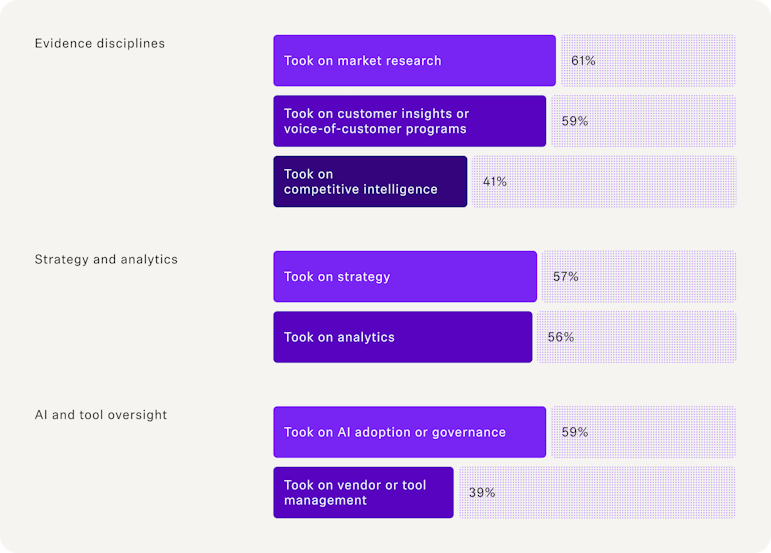
For example, a market-entry study may require customer interviews, competitor research, and product data, all while the research team manages other incoming requests. Managing these growing demands requires a deliberate approach to prioritizing, planning, and delivering research.
5 Best practices for scaling research during the squeeze
How you assess incoming requests, choose research methods, and allocate your team's time can help you take on more work without stretching resources further. The goal is to support more informed business decisions with the research capacity you already have.
Here are five practices to help you make those decisions:
- Decide what deserves research
- Match the depth of research to the decision
- Start from what you already know
- Hand repetitive work to AI, keep the judgment
- Set clear rules before you scale
Let’s look at each practice and how you can apply it to your research workflow.
1. Decide what deserves research
When research requests exceed your team's capacity, you need clear criteria for deciding which projects to take on, postpone, or decline. Prioritize requests based on the business decisions they support.
Consider four questions when evaluating research requests:
- Business impact: What decision will the research inform, and who will act on the findings?
- Timing: When will stakeholders make the decision, and can the research influence it?
- Existing evidence: Can previous studies or customer data answer the question?
- Priority: What happens if the research is postponed or the decision moves forward without it?
These criteria can guide research prioritization. Prioritize projects tied to important upcoming decisions, postpone requests without clear deadlines, and decline studies that duplicate existing findings.
A weekly review of incoming requests can help you put this into practice. Categorize each request as an immediate priority, something to revisit later, or a question that doesn't require a new study. Record the decision each request supports so stakeholders understand why certain projects take priority.
However, focusing only on immediate requests can leave little time for longer-term research.
When capacity is limited, longer-term and exploratory work is often deprioritized in favor of immediate business needs.
Andrea Esqueda
Marketing Researcher
Share
You should also make room for exploratory studies that investigate emerging customer needs and market changes. One way to protect this time is to reserve a recurring slot in your research roadmap for investigating new questions, rather than filling your schedule exclusively with incoming requests.
For example, Theresa Manteiga, former Head of Market Research at Asana, uses informal conversations with stakeholders to learn about upcoming projects and adjust her research plans before decisions are made. This builds research influence and helps you contribute to business decisions earlier.
2. Match the depth of research to the decision
The amount of research a project needs depends on the consequences of getting the decision wrong. Major business decisions often require more time, multiple research methods, and stronger supporting evidence. Smaller changes can usually be tested and validated faster.
In our 2026 State of Market Research Report, we call these high-stakes choices ‘one-way-door decisions’. These decisions carry significant financial, strategic, or business risks and are difficult to reverse.
Here are two examples of how research depth can vary:
- Deep research: Before discontinuing a product, a team might combine customer interviews, usage and retention data, and surveys across customer segments to understand how the decision could affect existing customers and revenue
- Quick research: When updating onboarding instructions, a short usability test with a few participants can reveal whether users understand the revised steps and where they encounter difficulties
3. Start from what you already know
Reviewing existing interviews, surveys, customer feedback, and product data helps identify what's already known, what needs updating, and what still needs investigation.
This helps narrow the scope of new research and reduces time spent investigating questions your team has already explored.
For each new request, put together a short summary of the existing evidence. Include what previous studies found, which customer groups they covered, when the research was conducted, and what is unanswered.
For example, if previous research explains how existing customers evaluate your pricing, a new study can focus specifically on a different customer segment instead of repeating the entire study.
A typical study that would have taken a month or two, I now need to turn around in a week. We self-serve data analysis, mine user research interviews, and synthesize existing research much more efficiently. In the past, I might have outsourced a project entirely or kept it in-house. Now, most projects are a hybrid hand-off between internal and external people and tools, each contributing to the process before handing off to the next. The result is that researchers are more project managers now than ever before.


Theresa Manteiga
Head of Market Research at Asana
Share
Building on previous research also requires a shared understanding of what your organization knows.
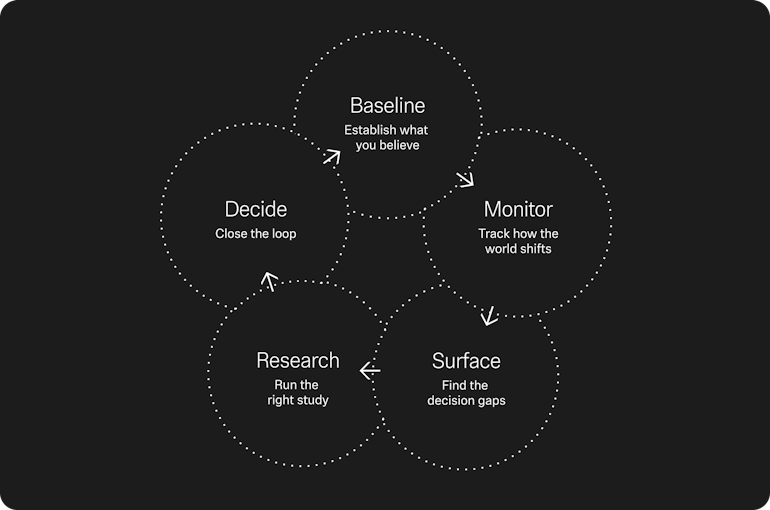
Our System of Learning Playbook introduces a five-stage framework: baseline, monitor, surface, research, and decide. The framework helps teams track what they already know, identify changes in customer needs, and investigate unanswered questions.

4. Hand repetitive work to AI, keep the judgment
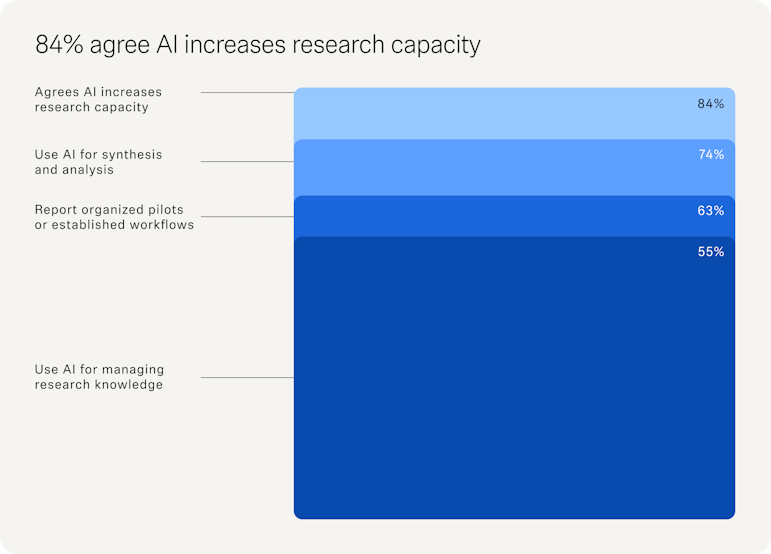
AI can help researchers spend less time on repetitive tasks such as study planning, data analysis, and reporting, which add to the research challenges teams already face. 84% of respondents agree that AI increases research capacity, while 74% use it for synthesis and analysis.

However, researchers still need to decide which tasks AI can handle and where researchers still need to apply their expertise.
Research task | What AI can help with | What researchers should own |
|---|---|---|
Study planning | Draft study plans, survey questions, and interview guides | Define research objectives, confirm suggested methods, and check questions for bias |
Data analysis | Summarize interview transcripts, identify themes, and organize responses | Verify findings against original data, investigate conflicting responses, and interpret results |
Reporting | Draft research summaries, presentations, and reports | Validate conclusions, identify important findings, and recommend next steps |
Interview moderation | Conduct interviews with real participants and generate follow-up questions | Decide when researcher-led conversations are needed to explore complex or sensitive topics |
Human judgment becomes particularly important when AI contributes to research findings. For example, AI-moderated interviews collect feedback from real participants, while synthetic data generates simulated responses.
Researchers have different levels of trust when AI contributes to the research findings themselves. 62% of respondents trust AI-moderated research, compared with 46% who trust synthetic data for important decisions. Researchers must therefore assess whether simulated responses fit the research question or whether real participant feedback is necessary.
The same applies when AI analyzes real participant data. For example, if AI identifies pricing as a recurring concern, a researcher can review the original responses, check which customer segments raised the issue, and determine whether the findings support a broader recommendation.
Greater AI use had little connection to whether researchers felt they had enough resources to meet demand. So, while AI can speed up individual tasks, teams still face growing research requests, limited budgets, and competing priorities.
5. Set clear rules before you scale
As UX and market researchers use AI across more stages of the research process, they need clear rules on which tasks AI can handle, when human review is required, and who is responsible for checking findings before sharing them with stakeholders.
Only 55% of respondents have clear standards for when AI can and can't be used. Just 17% said AI was integrated across their research process with clear ownership.
The report recommends three areas for establishing consistent AI workflows:
- Clear ownership: Assign responsibility for approving AI tools, setting research standards, and reviewing findings before they're shared with stakeholders
- Human review: Establish which AI-generated outputs need review, with stronger checks when AI is used to collect, analyze, or interpret research findings
- Approved workflows: Create research templates and guidelines that help teams apply AI consistently across projects
For example, a research lead could approve the AI tools and templates used across the team, while individual study owners review AI-generated questions before launch and verify findings before sharing them with stakeholders. Higher-stakes studies may also run through a second review to confirm that recommendations are supported by participant data and that any use of simulated responses is clearly identified.
Angie Liang, Independent Research Leader, highlights the risk of over-relying on AI in research:
AI can give us a false sense of conviction. We can scour past research, behavioral data, and competitive intelligence to build a hypothesis or gut-check an idea in minutes. But speed can make new research feel like a delay. The researcher’s judgment lies in knowing when an existing signal is strong enough to act on and when new research is needed to surface the context or nuance a decision requires.


Angie Liang
Independent Research Leader
Share
How Maze helps with proactive research
To scale research, teams need a way to run more studies, reduce manual work, and build on previous findings.
Maze brings these workflows into one platform.
Teams can start with research templates or use the AI study builder to create structured studies with built-in research guidelines. Maze’s AI moderator conducts interviews with real participants, and research-grade AI helps maintain quality by evaluating conversations against 25 quality metrics.
With Maze MCP, researchers can also connect existing studies, transcripts, and findings to AI tools like ChatGPT and Claude. This makes it easier to revisit previous insights, identify knowledge gaps, and focus new studies on unanswered questions.
Maze helps research teams scale research without sacrificing rigor, depth, or trust.

FAQs about the research squeeze
What is the research squeeze?
What is the research squeeze?
The research squeeze describes the growing pressure on research teams to deliver more studies, meet tighter deadlines, and manage increasingly complex projects without matching increases in budget or headcount.
How to scale research without more headcount?
How to scale research without more headcount?
You can scale research without more headcount by prioritizing high-impact projects, reusing existing findings, automating repetitive tasks with AI, and choosing research methods based on the importance of each decision.
How should research teams prioritize requests?
How should research teams prioritize requests?
Research teams should prioritize requests based on business impact, urgency, available evidence, and whether the findings will influence a decision. Projects with unclear objectives or findings already covered by previous research can be postponed or declined.
How do you balance speed and quality in research?
How do you balance speed and quality in research?
Balancing speed vs. quality in research means choosing the right level of research for each decision. High-stakes decisions require deeper investigation and multiple sources of evidence, while smaller, lower-risk decisions can be informed by quick surveys or usability tests.
How can AI help research teams keep up with demand?
How can AI help research teams keep up with demand?
AI helps researchers save time on study planning, drafting questions, analyzing data, and preparing reports. AI-moderated interviews can also help teams collect feedback from more participants, leaving researchers more time to interpret findings and support business decisions.
What is the AI confidence gap in research?
What is the AI confidence gap in research?
The AI confidence gap refers to the difference between growing AI adoption and researchers' confidence in using it responsibly. In Maze’s State of Market Research Report, 84% of respondents agree that AI increases research capacity, but only 55% have clear organizational standards for its use.
How do you use AI ethically in market research?
How do you use AI ethically in market research?
Ethical AI use in market research starts with AI governance policies. These include protecting participant privacy, being transparent about AI use, and having humans review AI-generated findings. Researchers should also distinguish between real participant feedback and synthetic data, especially when the findings inform important business decisions.