









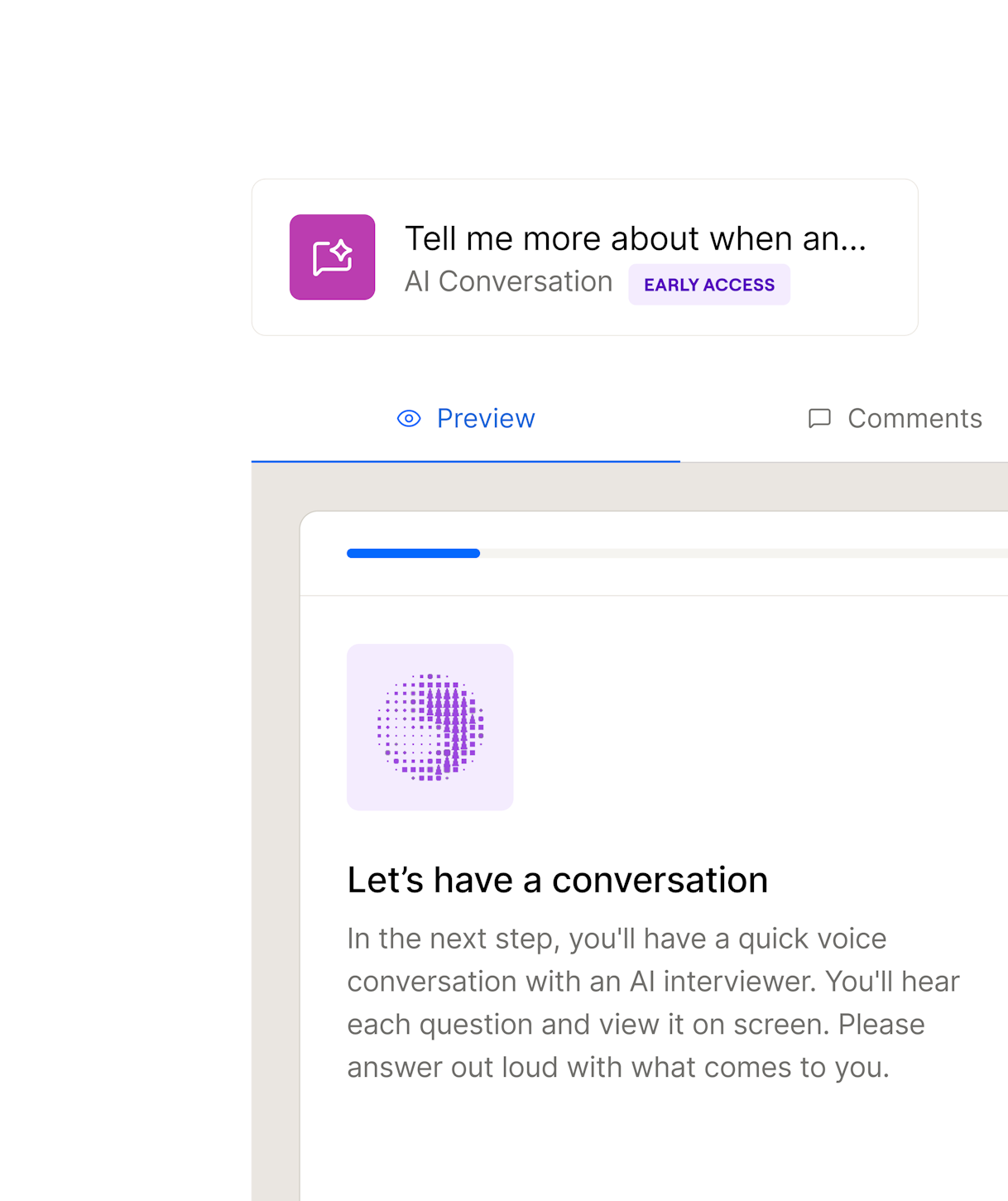



Today, we’re introducing AI conversation block: adaptive, AI-moderated conversations built directly into any unmoderated Maze study.
It’s the latest addition to Maze AI—alongside AI study builder, AI moderator, and Maze MCP—giving researchers more ways to understand the human experiences and motivations behind the data, while keeping them at the center of the decisions that follow.
Researchers can now combine behavioral testing and follow-up conversations in the same study, with the same participants, in the same session. You can see what people do—task success, paths taken, misclicks, ratings, and more—then ask why while it’s still fresh.
That means less time stitching together insights from different studies and moments, and a more connected view of the people taking part in your research.
Bringing behavior and understanding together

Researchers have always known that behavior and context tell different parts of the story.
A usability study can show you where participants struggled, where they hesitated, and which paths they took. But the same behavior can have very different explanations. A participant might hesitate because they’re confused, comparing options, or because something they’ve encountered before is influencing their decision.
The behavior gives you the signal, and the conversation gives you the context.
Until now, those two pieces have typically lived in separate research workflows. You might run a usability study to identify patterns, then follow up with interviews to understand what was behind them. By then, you’re often working with a different group of participants, in a different moment, asking people to remember rather than explain it as it happens.
The AI conversation block brings adaptive conversation directly into the study experience.
What it looks like in practice
Imagine you’re testing a new onboarding flow. A participant completes your prototype task, and Maze captures the behavioral data: they successfully finish, but hesitate when choosing a plan and spend longer than expected exploring their options.
Instead of stopping at the behavior, an AI conversation block follows up in the moment. The participant explains they weren’t sure which option would best support their growing team, and a follow-up question uncovers what information would have helped them make the decision with more confidence.
Now you have both sides of the story: the behavioral pattern and the participant’s explanation for it. And because the conversation is part of the same study, that context stays connected to the behavior it helps explain.
Flexible conversations built into your study flow
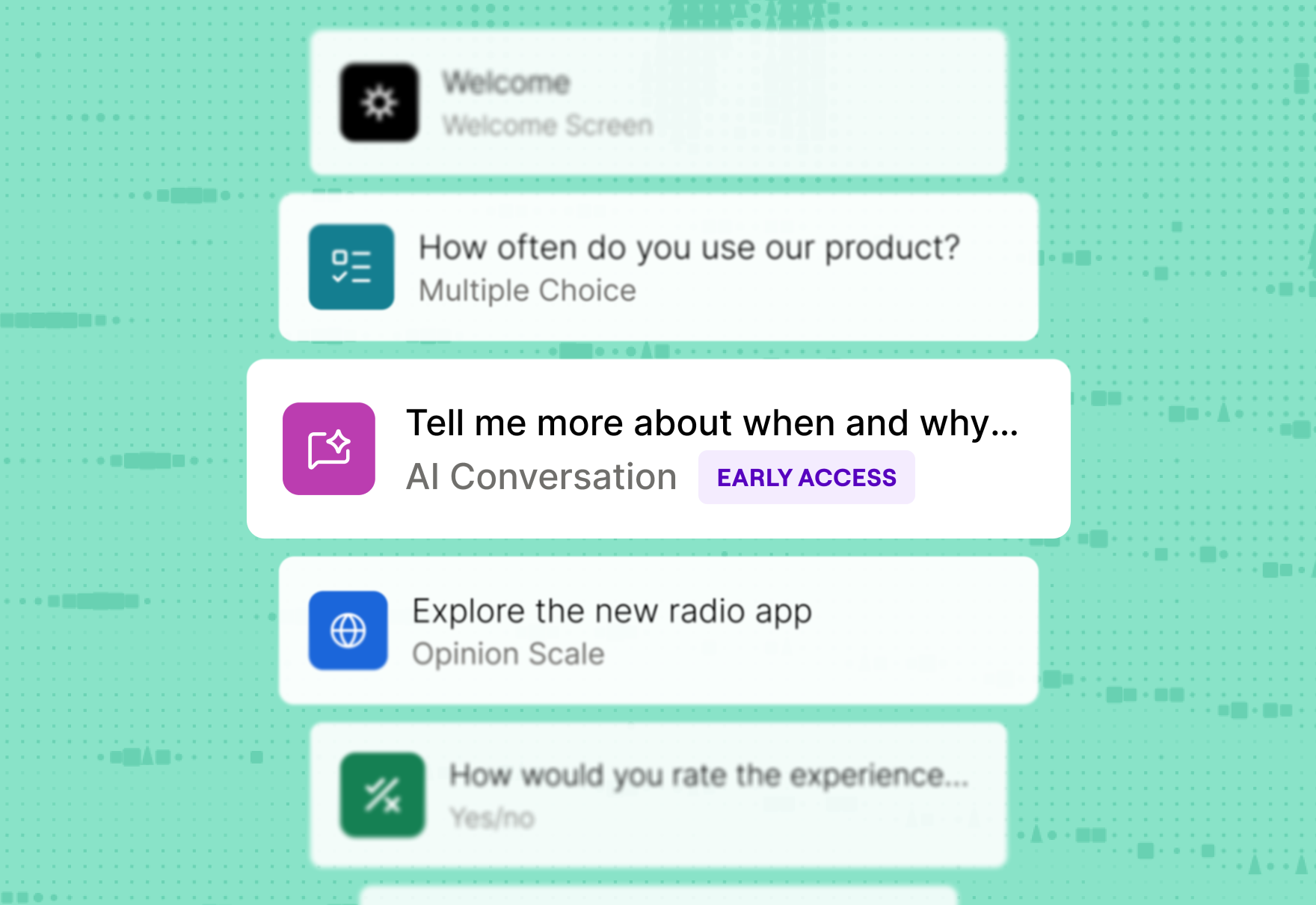
Just like other blocks, the AI conversation block isn’t limited to one point in a study. You have the freedom to add it wherever a deeper understanding is useful, whether that’s before or after an interaction.
You might use it at the beginning of a study to understand participants’ expectations before they interact with your product. You could place it after a prototype task to explore a moment of friction, or follow up after a rating question to understand why someone scored highly or poorly. With conditional logic, you can also tailor conversations based on the participant's responses.
That flexibility also means you can choose the right kind of AI conversation for the research question you’re trying to answer.
If you’ve used Maze’s AI moderator, you might be wondering where the AI conversation block fits in. Both help researchers have richer conversations with participants, but they’re designed for different moments in the research process.
Use the AI conversation block when behavior is central to your study, and you want to understand a specific moment:
- Why did participants hesitate during this task?
- What made this decision difficult?
- What influenced their rating?
Use the AI moderator when the conversation is the research itself:
- Exploring user needs
- Identifying workflows
- Conducting discovery research
- Digging into broader motivations
Many teams will use both across their research workflow. A usability study might uncover an unexpected behavioral pattern, with AI conversation block helping you understand what happened in that moment. From there, AI moderator can help you explore the broader context and motivations behind what you heard.
A new way to connect the what with the why
AI conversation block brings quantitative and qualitative research into the same study. When you can see what happened and ask about it in the same session, you spend less time piecing together separate sources of data and more time uncovering what’s behind the behavior.
As AI becomes a bigger part of research, we’re continuing to be intentional about how we build with it. 82% of researchers say interpreting nuance and emotion still requires human judgment, and that judgment remains central to deciding which signals matter, how different pieces of evidence fit together, and where research should take a product next.
At Maze, our research-grade AI is designed to support that work, with the transparency and quality researchers need to stay close to the research and the people behind it. AI can help researchers reach more people, explore more questions, and go deeper into what’s behind the data. Researchers bring the judgment to make sense of it and decide what happens next.
The more connected your research is, the more confidently you can act on it.