









Chapter 5
How many research participants do you need?
TL;DR
- The number of research participants you need depends on the method, audience, and decision your study needs to support
- Qualitative methods like usability testing, interviews, focus groups, and diary studies usually need smaller samples to uncover patterns in behavior
- Quantitative methods like surveys, card sorting, tree testing, benchmarks, and A/B tests need larger samples to reduce margin of error and measure results at scale
- Once you know the right sample size, Maze can help you calculate participant needs and recruit the right audience for your study
Your sample size affects the quality of your findings and the time and budget needed to complete the research—so getting it right is a priority. Recruit too few participants, and you may miss important patterns. Recruit too many, and you can end up collecting more data than your study needs.
In this guide, we look at how participant numbers vary across common UX research methods, what to consider before choosing a sample size, and how to recruit the right participants for your research goals. We also include a handy sample size calculator to help you make sure you’re recruiting the right number of users for your study.
Qualitative vs. quantitative: Why it changes everything
The number of research participants you need depends on the question your study looks to answer.
Qualitative research helps you understand user behavior in context. It helps you explore how people complete tasks, what they expect, and why they make certain decisions. Since each session can include detailed feedback, observations, recordings, and follow-up questions, you usually need fewer participants than you would for quantitative research, but enough to see where the same issues, expectations, or behaviors appear more than once.
Quantitative research measures user behavior or attitudes at scale. It helps you answer questions about frequency, performance, preference, or confidence. For example, you might want to know how many users completed a task, which version performed better, or how satisfied users were after using a feature. Since the goal is to measure trends across a larger group, quantitative studies usually need a larger sample size.
Qualitative and quantitative research need different sample sizes because they answer different kinds of questions. Usability testing sits right in the middle of that conversation. Some usability tests are qualitative, helping teams find where users struggle and why. Others are quantitative, measuring task success, time on task, error rates, or completion rates across a larger group.
That’s why blanket sample-size rules can be misleading.
💡 Tip: The five-user rule is often cited as the ideal number of research participants, but it only applies to certain usability tests. It shouldn’t be treated as a rule for every research method, study type, or research goal. We’ll look at when it works and when it doesn’t in the next section.
The 5-user rule in usability testing: What it actually means and drawbacks
The five-user rule comes from Jakob Nielsen’s guidance at Nielsen Norman Group. It says that testing with five users can uncover around 85% of usability issues in the first round of a qualitative usability test. But that finding depends on context. This means that if you’re observing a relatively similar group of users completing the same tasks in one design, prototype, or flow, you can use what you learn to improve the experience and test again.
But the five-user rule isn’t a universal sample size recommendation. It’s mainly useful for early, formative usability testing when you’re trying to identify obvious issues in a single design, prototype, or flow.
In practice, testing with more than five users should depend on your study goal, product risk, audience complexity, and how specific your participant recruitment criteria need to be.
Here’s when you should consider using more testers to uncover key insights:
- Your user base includes distinct groups: If your product serves different roles, experience levels, markets, or accessibility needs, five participants may not capture enough user variation. For example, a finance platform used by both first-time investors and professional advisors will likely need separate studies and participant groups for each user profile.
- The product or workflow is high risk: Products in areas like healthcare, financial services, insurance, or enterprise security often need more thorough testing because usability issues can have serious consequences. In these cases, a small sample may be useful for early discovery, but it shouldn’t be the only evidence used before launch.
- You’re still finding new issues after the first sessions: If each new participant reveals different problems, your sample may be too small. More sessions can help you understand whether those issues are isolated or part of a wider pattern.
- You need to test critical paths or complex flows: A simple prototype test may work with fewer participants, but longer or more complex user journeys often need more coverage. This is especially true for checkout flows, onboarding, navigation, accessibility, account setup, or mobile experiences, where small usability issues can impact task completion.
- You’re measuring performance after launch: Once a product is live, you may need a larger sample to understand usage at scale. Post-launch research often includes tracking usability metrics, like task success rates, feature adoption, website analytics, and other data points that help teams prioritize improvements.
The five-user rule is useful, but only in a narrow usability testing context. For most research, sample size depends on the research method, question, and the level of confidence you need.
Next, let’s look at how many participants you may need across common research methods.
Sample size by research method
There’s no single sample size that works for every study. The right number of participants depends on your research method, the audience you’re studying, and how complex or high-stakes the research is.
Based on our experience at Maze, however, there are useful starting points you can use when planning user research. These aren’t fixed rules, but can be considered as benchmarks you can scale up or down depending on the scope, risk, and goals of your study.
Here’s a good starting sample size for each research method, along with when you may need to scale that number up or down:
Research method | Research phase | Good starting sample size | Scale up when... | Scale down when... |
|---|---|---|---|---|
Stakeholder interviews | Discovery | 5–10 key stakeholders across relevant teams | For complex organizations, include 10–15+ stakeholders to represent different departments and surface priorities that may not be aligned. | For a small team with shared priorities, 3–5 stakeholders can provide enough context to inform the research. |
In-depth user interviews | Discovery / Definition | 5–8 participants for a standard, focused round | A broader or more exploratory study may need 10–20 participants to capture a wider range of experiences. For a very broad or varied audience, this can increase to 20–30 participants. | For a narrow, low-risk research question, as few as 3 participants can provide an early directional read. |
Surveys | Discovery | 50 respondents for a standard, medium-risk directional survey | Use 100–200+ respondents when the findings need to inform a broader or more strategic decision. A broad audience may require 300–400+ respondents, particularly when you need a defined confidence level and margin of error. Plan the sample separately when comparing segments. | For a low-risk quick-pulse survey, as few as 20 respondents can provide useful directional feedback. |
Focus groups | Discovery | 5–8 participants per group | A relatively simple topic can accommodate up to 10 participants per group. If you need to hear from several audience segments, plan 3–6 groups, or around 18–60 participants in total. | For complex or sensitive topics, 4–5 participants per group gives each person more opportunity to contribute and reduces the effect of group dynamics. |
Diary studies | Discovery | 10 participants for a standard diary study | Broader or more strategic studies may need 15–20 participants. When comparing distinct segments, aim for 5–10 participants per segment. For longer studies, recruit above your target to allow for participant drop-off. | A short, simple, or low-risk diary study may only need 5 participants when the goal is an early directional understanding of behavior. |
First-click testing | Definition | 15–30 participants for directional navigation feedback | Increase to 50–100 participants when comparing segments, devices, or experience levels, or when the findings will inform a high-stakes decision such as a major redesign or conversion-critical flow. | First-click tests generally need at least around 15 participants. With a smaller group, there may not be enough first-click data to identify meaningful navigation patterns. |
Card sorting | Definition | 20 participants for a standard card sort | For strategic navigation, taxonomy, or hierarchy decisions, 30–150 participants can provide greater confidence in the patterns. A larger sample is also useful when comparing multiple audience segments. | 10–15 participants can work when you only need an early directional view of how people group and categorize information. |
Tree testing | Definition | 50 participants for a standard tree test | When comparing different tree versions or user segments, plan for around 30 participants per version or segment. High-stakes information architecture decisions may also justify a larger overall sample for greater confidence. | 15–30 participants can be useful for an early check of a proposed structure before moving into more robust validation. |
Concept testing | Definition | 5 participants for a standard concept check | Use 8–10 participants when the concept supports a more strategic or higher-stakes decision. If you need statistically reliable results across a broader audience, use a quantitative survey and calculate the sample accordingly. | For an early check of a rough, low-risk concept, 2–3 participants can be enough to surface initial reactions and obvious concerns. |
Collaborative design sessions | Definition | 3–5 participants for a standard collaborative design session | A more strategic or exploratory initiative can include up to 8 participants when additional perspectives would meaningfully contribute to the work. | There is rarely a reason to go much smaller. 3 participants can already support close, hands-on collaboration, and these sessions tend to work best with a small, consistent group. |
Usability testing | Definition / Delivery | 10 participants for an unmoderated test of a mid-to-high-fidelity prototype | Use 20+ participants when testing a finished or live product, comparing design variants, working across multiple user segments, or conducting a more strategic and exploratory study. | Smaller samples suit more focused testing. Plan for 5–10 participants in moderated sessions, 2–5 for an early low-fidelity prototype, or 3–5 per round for rapid iterative prototype testing. |
Content testing | Delivery | 10 participants per qualitative round | Increase to 15–20 participants when testing several content variations or audience segments. For quantitative comprehension or preference testing, plan for 30+ participants. | Keeping the sample close to 10 participants helps you distinguish recurring clarity or comprehension problems from isolated reactions, so scaling down is rarely useful. |
Live website testing | Delivery | 20–30 real visitor sessions | Use 100+ sessions when you need more reliable behavioral data across the live audience or want to compare user behavior before and after a change. | If traffic is limited, give the study more time to reach the target number of sessions rather than relying on a smaller data set. |
Continuous feedback | Delivery | No fixed sample size. Feedback accumulates continuously as users interact with the product. | For broader trend analysis or comparisons between segments, wait until you have a steady 50–100+ responses within a defined period, such as a month. | There is no minimum target for collecting continuous feedback. At lower volumes, individual responses can still surface useful issues, but they should be treated as directional rather than representative trends. |
A/B testing and experiments | Delivery | 100+ conversions per variant as a rough minimum | A smaller expected uplift may require 300+ conversions per variant to detect reliably. Multivariate tests can require thousands of users across combinations, while high-traffic feature-flag rollouts may involve hundreds of users at each stage. | When traffic is limited, keep the experiment to a simple A vs. B comparison and let it run longer. Use a sample size calculator first to check whether the test can realistically reach the required sample. |
Stakeholder interviews
Stakeholder interviews help you understand the priorities, constraints, assumptions, and expectations of the people involved in or affected by a project. They’re usually conducted early in the discovery stage.
For a standard round, plan for 5–10 key stakeholders across the relevant teams. The goal is to only include the people who can provide different perspectives on the problem, users, business goals, and project constraints.
You can scale down when the organization is small and stakeholders are already well aligned. For a simple project or a small team, 3–5 stakeholder interviews may be enough to capture the main priorities and requirements.
You’ll need more interviews when the organization is more complex. Plan for 10–15+ stakeholders if the project spans several departments or teams have different or conflicting priorities.
Research method: Stakeholder interviews | Good starting sample size |
|---|---|
Standard stakeholder interview round | 5–10 key stakeholders |
Small or well-aligned organization | 3–5 stakeholders |
Complex organization or conflicting priorities | 10–15+ stakeholders |
In-depth user interviews
For in-depth user interviews, plan for 5-8 participants for a standard, focused round. This can work well when you’re speaking to a relatively consistent user group and exploring a specific set of needs, behaviors, or experiences.
Increase the sample to 10–20 participants when the study is more strategic or exploratory, or when your audience is broader or more varied. For example, you may need more interviews if you’re speaking to people across different roles, markets, experience levels, customer segments, or use cases.
For very broad or varied audiences, you may need to scale further to 20–30 participants. In these cases, the larger sample gives you more opportunity to understand how experiences differ across the audience rather than assuming insights from one group apply to everyone.
Research method: In-depth interviews | Good starting sample size |
|---|---|
Standard, focused round | 5–8 participants |
Strategic, exploratory, or broader study | 10–20 participants |
Very broad or varied audience | 20–30 participants |
Narrow, low-risk, or tactical check | As few as 3 participants |
Surveys
User surveys can help you gather qualitative insights from users like their needs, motivations, and behaviors. The number of participants needed for a survey depends on project complexity, which reflects the potential impact of UX design decisions on the user experience and business outcomes.
For a standard, medium-risk directional survey, start with around 50 respondents. This can work when you need a useful read on patterns or preferences without treating the findings as statistically representative of a much larger audience.
For a low-risk quick-pulse survey, as few as 20 respondents can be enough to get an early directional signal before deciding whether more research is needed.
Aim for 100–200+ respondents when you need more generalizable results for a broader or more strategic decision. If you’re comparing different user segments, plan the sample separately for each segment so that every group has enough responses to analyze meaningfully.
For research across a broad audience, 300–400+ respondents may be appropriate when you need a specific confidence level and margin of error. In these cases, rather than relying on a fixed rule of thumb, use a sample size calculator that accounts for your population size, confidence level, and acceptable margin of error.
Research method: Surveys | Good starting sample size |
|---|---|
Low-risk quick-pulse survey | As few as 20 respondents |
Standard, medium-risk directional survey | 50 respondents |
Broader or strategic survey | 100–200+ respondents |
Survey for a broad audience with a defined confidence level and margin of error | 300–400+ respondents, using a sample size calculator |
Survey across multiple segments | Plan the sample separately for each segment |
Focus groups
A focus group is a moderated group discussion used to explore participants’ reactions, attitudes, opinions, and language around a topic.
For focus groups, plan for 5–8 participants per group. That’s usually small enough for each person to contribute effectively, but large enough to create discussion between participants.
You can scale up slightly when the topic is relatively simple, and more voices are likely to add value. In these cases, up to 10 participants per group can work well.
If you’re researching multiple audience segments, you’ll usually need more than one group. In such a case, plan for around 3–6 focus groups, or roughly 18–60 participants in total, depending on how many segments you need to cover and whether each group needs to be analyzed separately.
You may also want to scale down for complex or sensitive topics, or discussions that may be heavily influenced by group dynamics. Here, smaller groups of 4–5 participants can work better. This makes it easy for each participant to explain their views and for the moderator to explore important points in more depth.
Research method: Focus groups | Good starting sample size |
|---|---|
Standard focus group | 5–8 participants per group |
Simple topic where more voices are useful | Up to 10 participants per group |
Multiple audience segments | 3–6 groups, or roughly 18–60 participants total |
Complex, sensitive, or group-dynamic-heavy topic | 4–5 participants per group |
Diary studies
Diary studies track user behavior, routines, and experiences over time, so participants submit multiple entries across days, weeks, or months. That’s why diary studies usually work best with a smaller, focused sample. As a starting point, plan for 10 participants. This is often enough to identify patterns over time.
You can also scale down for narrower research. For a short, simple, low-risk, or tactical diary study, as few as 5 participants can work when you only need an early directional read.
You may need a larger sample when the research is broader or more strategic. Aim for 15–20 participants when you’re exploring a wider range of behaviors, comparing different types of users, or running a longer study where participant drop-off is more likely.
If you’re comparing distinct audience segments, plan for around 5–10 participants per segment. This gives each group enough representation to compare patterns without combining very different user experiences into one sample.
Research method: Diary studies | Good starting sample size |
|---|---|
Standard diary study | 10 participants |
Broader, more strategic, or longer diary study | 15–20 participants |
Diary study across multiple segments | 5–10 participants per segment |
Short, simple, low-risk, or tactical study | As few as 5 participants |
Study where drop-off is likely | Recruit above your target final sample |
First-click testing
First-click testing helps you understand where users click first when trying to complete a task. It’s especially useful for checking whether navigation, labels, and page structure point users in the right direction before you invest in deeper usability testing.
For a standard directional first-click test, start with around 15–30 participants. This is usually enough to identify recurring patterns in where people click first and spot obvious navigation or information architecture problems.
Aim for around 50–100 participants when you’re testing a major redesign, a conversion-critical flow, or an audience that spans different devices, experience levels, or user segments. A larger sample gives you more confidence that the patterns you see aren’t limited to one small group.
Research method: First-click testing | Good starting sample size |
|---|---|
Standard directional first-click test | 15–30 participants |
Major redesign or conversion-critical flow | 50–100 participants |
Multiple devices, experience levels, or user segments | 50–100 participants, with enough participants per group to compare results |
Very small sample | Not typically recommended below around 15 participants |
Card sorting
Card sorting is a generative UX research method used to develop or evaluate the information architecture of a product or site. Unlike usability testing, card sorting requires a larger number of users to achieve reliable results due to the variability in how people categorize information.
For a standard card sort, start with around 20 participants. This gives you enough responses to identify recurring grouping patterns and see where participants agree or differ in how they organize the content.
You can also scale down when you only need an early, directional read. Around 10–15 participants can work for a tactical or low-risk card sort where the goal is to explore how people categorize content before making more significant information architecture decisions.
You’ll need a larger sample when the results will influence navigation, taxonomy, or content hierarchy more broadly. For a strategic card sort, or when you need a lower margin of error, plan for around 30–150 participants. The right number within that range depends on how much confidence you need in the patterns you find.
Research method: Card sorting | Good starting sample size |
|---|---|
Standard card sort | 20 participants |
Early, directional, tactical, or low-risk card sort | 10–15 participants |
Strategic card sort or lower margin of error needed | 30–150 participants |
Card sort across multiple user segments | Plan a sufficient sample for each segment |
Tree testing
Often done after card sorting, tree testing helps evaluate the navigability of a system structure.
For a simple tree test, 50 participants can work as a minimum starting point. This can help you spot whether users are choosing the right paths, where they hesitate, and which labels cause confusion.
You can scale down when you only need an early directional read. Around 15–30 participants can work when you’re testing an initial structure before moving into deeper validation. At this stage, the goal is to spot obvious problems rather than make a high-confidence information architecture decision.
You’ll need a larger or more carefully divided sample when the study is complex. If you’re comparing different tree versions or testing multiple user segments, plan for around 30 participants per segment or version. This ensures each group has enough responses to analyze independently.
For a high-stakes information architecture decision, you may also want to increase the overall sample beyond the standard 50 participants. A larger sample can give you more confidence in the patterns you see before making significant changes to navigation or content structure.
Research method: Tree testing | Good starting sample size |
|---|---|
Standard tree test | 50 participants |
Early, directional tree test | 15–30 participants |
Multiple user segments or tree versions | Around 30 participants per segment/version |
High-stakes information architecture decision | Scale above the standard sample for greater confidence |
Concept testing
Concept testing helps you understand how users respond to a product, design, or marketing idea before you invest significant time and resources into developing it. It can be used early in discovery or later when you need to validate a particular direction before moving forward.
For a standard concept check, start with around 5 participants. This can be enough to understand whether people grasp the idea, how they react to it, and what questions or concerns come up repeatedly.
You can scale down when the concept is still rough and the decision carries little risk. For an early, low-risk, or tactical gut-check, as few as 2–3 participants can work. At this stage, the goal is to identify obvious problems or reactions before spending more time refining the idea.
For a strategic or higher-stakes concept decision, plan for around 8–10 participants. A larger group gives you more perspectives before deciding whether to develop, change, or discard the concept. If you’re running a product concept test, this can be particularly useful before committing significant resources to a proposed solution.
Research method: Concept testing | Good starting sample size |
|---|---|
Standard concept check | 5 participants |
Early, low-risk, or tactical gut-check | 2–3 participants |
Strategic or higher-stakes concept decision | 8–10 participants |
Quantitative concept validation across a broader audience | Use the sample-size guidance for surveys |
Collaborative design sessions
Co-design, or collaborative design, brings users or other relevant participants into the design process to help shape a solution. Participants might work with the research or product team to explore ideas, map out an experience, prioritize needs, or develop possible solutions together.
For a standard collaborative design session, start with around 3–5 participants. Co-design is hands-on, so a small group gives everyone enough opportunity to contribute, discuss ideas, and work directly with the team.
You may want to scale up when the project is more strategic or exploratory and would benefit from a wider range of perspectives. In these cases, you can include up to around 8 participants. Beyond that, collaborative sessions can become harder to manage and give each person less opportunity to contribute meaningfully.
Research method: Collaborative design sessions | Good starting sample size |
|---|---|
Standard collaborative design session | 3–5 participants |
Strategic or more exploratory initiative | Up to 8 participants |
Small, hands-on collaborative work | 3 participants can often be enough |
Usability testing
For an unmoderated usability test of a mid-to-high-fidelity prototype, a good starting point is 10 participants. This works well when you’re testing one user group, one prototype, or one flow and want enough responses to identify recurring usability issues.
Remember, the number of participants you need for every study changes depending on how the test is run, the stage of product development, and what you need to learn.
Moderated and unmoderated usability tests also have different sample size needs. In a moderated test, the researcher can ask follow-up questions, observe behavior in real time, and dig into why a participant struggled. So, 5–10 participants can often be enough for a moderated round.
You can go even smaller when you’re testing an early, low-fidelity prototype. In this case, 2–5 participants can give you enough feedback to identify obvious problems before investing more time in the design.
The same applies when you’re running rapid, iterative rounds of prototype testing. Around 3–5 participants per round can work well because the goal is to identify usability issues, make improvements, and test again with a new group.
You may need 20+ participants when testing a finished or live product, comparing multiple design variants, or working with multiple user segments. Larger samples can also be useful for strategic or exploratory usability studies where you need to understand a wider range of behaviors and experiences.
Research method: Usability testing | Good starting sample size |
|---|---|
Unmoderated test of a mid-to-high-fidelity prototype | 10 participants |
Moderated usability testing | 5–10 participants |
Early, low-fidelity prototype testing | 2–5 participants |
Rapid, iterative prototype testing | 3–5 participants per round |
Finished or live product, multiple variants, or multiple user segments | 20+ participants |
Content testing
Content testing helps you understand whether the words, information, and other content within a product or website are clear, useful, and easy for users to understand.
For a standard qualitative content test, start with around 10 participants per round. This gives you enough feedback to spot recurring issues with clarity or comprehension without making the study unnecessarily large.
The right number can change depending on what you’re testing. There are several content testing methods, including task-based usability testing, cloze tests, card sorting, highlighting tests, and five-second tests. If you’re testing multiple content variations or comparing different user segments, increase the sample to around 15–20 participants so you have enough feedback to assess the differences between them.
For preference testing across a broader audience, plan for 30+ participants. At that point, the goal is less about exploring why individual users respond a certain way and more about identifying patterns across a larger group.
Research method: Content testing | Good starting sample size |
|---|---|
Standard qualitative content test | 10 participants per round |
Multiple content variations or user segments | 15–20 participants |
Quantitative comprehension or preference testing | 30+ participants |
Live website testing
For live website testing, start with around 20–30 real visitor sessions. This can be enough to spot recurring navigation or path patterns, like where visitors repeatedly take an unexpected route or struggle to reach an important part of the site.
You’ll need more data when you want to move beyond identifying patterns and make statistically reliable comparisons. Aim for 100+ sessions when you need stronger behavioral evidence across your live audience or want to compare performance before and after a change.
Research method: Live website testing | Good starting sample size |
|---|---|
Standard live website test | 20–30 real visitor sessions |
Statistically reliable behavioral analysis | 100+ sessions |
Before-and-after comparison | 100+ sessions |
Low-traffic website | Run the test longer to reach the required sample |
Continuous feedback
Continuous feedback works differently from a one-time research study. There’s no fixed number of participants to recruit upfront because feedback is collected as an ongoing stream while users interact with your product. You ideally want to identify patterns that emerge over time rather than reach a single sample-size target.
At lower volumes, individual responses can still highlight useful problems, requests, or opportunities. But if you want to identify more reliable trends or compare feedback across user segments, look for a steady 50–100+ responses within a defined period, such as a month.
Research method: Continuous feedback | Good starting sample size |
|---|---|
Ongoing product feedback | No fixed sample size |
Identifying reliable trends over time | 50–100+ responses per period |
Comparing feedback across segments | 50–100+ responses per period, with enough responses to assess each segment |
A/B testing and experiments
Unlike methods focused on user behavior and preferences, A/B testing relies on quantitative data to inform decisions. With A/B testing, your design team presents two variations of a design or prototype to measure which one resonates better with users. There are also several testing methods to choose from for A/B tests.
For a standard A/B test, 100+ conversions per variant is a useful rough minimum. This can give you enough data to start evaluating whether one version performs differently from another, although the exact sample you need will depend on your baseline conversion rate.
If you expect a smaller uplift, plan for 300+ conversions per variant. Smaller differences are harder to detect reliably, so you need more data to separate a genuine improvement from normal variation.
The sample size increases further as experiments become more complex. Multivariate tests can require thousands of users across all combinations because traffic is divided between several variations rather than just an A and B version.
Research method: A/B testing and experiments | Good starting sample size |
|---|---|
Standard A/B test | 100+ conversions per variant as a rough minimum |
A/B test with a smaller expected uplift | 300+ conversions per variant |
Multivariate test | Thousands of users across combinations |
High-traffic feature-flag rollout | Hundreds of users at each rollout stage |
Low-traffic A/B test | Keep it to A vs. B, run it longer, and check feasibility with a sample size calculator |
With Maze, you can run variant comparison and create custom expected paths for each version using testing templates. You can also directly test a prototype for multiple variables, then simply share the test with recruited users via a link, collect their answers, and get an automated report with success rates and alternative paths.
Factors impacting sample size
While we've explored the need for more testers in specific user testing scenarios, let's take a look at some general factors that can help you decide how many testers to recruit for well-rounded, inclusive UX research:
- Confidence level: This is the likelihood that your results accurately reflect the true experience of your entire user base. Essentially, the confidence interval measures how certain you can be that the outcomes aren't down to chance. The industry standard for confidence level is between 90-95%. Aiming for a higher confidence level, closer to 95%, means you'll need a larger number of testers to ensure the data is robust. More testers increase the reliability of your results but also impact the cost and time of testing.
- Criticality of your project: Highly critical projects—like medical devices, security services, or key business platforms—demand more rigorous testing to prevent costly or harmful errors. For these, you may need to expand your pool of testers beyond standard practices to ensure the design meets the strictest criteria for usability, safety, and security.
- Type of data you're collecting: The type of data you're collecting—quantitative or qualitative—also dictates the number of users needed for testing. For example, a user interview session might involve 5–8 participants for a standard, focused round, providing rich qualitative data On the other hand, card sorting typically requires a larger sample because you’re looking for recurring patterns in how people categorize information. Start with around 20 participants for a standard card sort, or 30–150 when you need greater confidence in navigation, taxonomy, or hierarchy decisions.
Use Maze's sample size calculator
The ranges above are a useful starting point, but your final sample size should reflect your study setup. Maze’s sample size calculator helps you estimate how many participants you need based on your methodology, population size, and confidence level.
Use it to check your ideal participant count before recruitment, align stakeholders on the sample size, and plan whether you’ll recruit from your own users, an external panel, or both.
Then, once you know the number of participants you need, Maze can help you recruit them.
💡 Use Maze’s sample size calculator to estimate how many participants your study needs
How Maze helps you recruit the right number
Once you know how many participants you need, Maze helps you recruit the right audience and hit your target sample size without managing the process across separate tools.
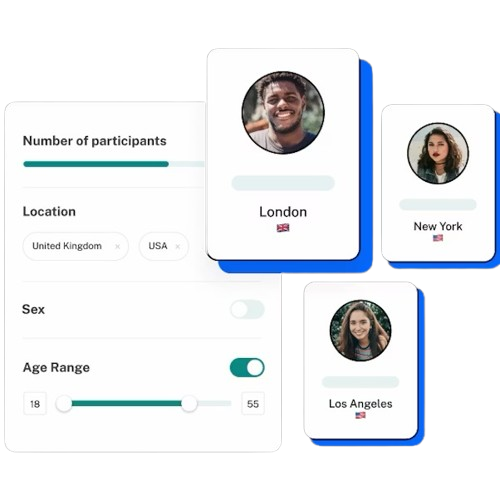
Once you know how many participants you need, the Maze panel gives you access to millions of vetted B2B and B2C participants across 150+ countries, using 400+ filters to target by demographics, work, lifestyle, and more.
With in-product prompts, you can collect feedback or recruit participants while they’re actively using your product, with targeting based on specific URLs or cohorts through integrations like Amplitude.
Maze helps you recruit the right participants for your study.

Frequently asked questions about how many research participants you need
How many participants do I need for a qualitative study?
How many participants do I need for a qualitative study?
For most qualitative studies, plan for 3-10 participants, depending on the method. For example, a moderated usability test may need 5-10 participants, while in-depth user interviews often need 5-8 participants for a focused audience. Use a larger sample if you’re studying multiple user segments, complex workflows, or a broader audience with varied needs.
How many participants do I need for a survey?
How many participants do I need for a survey?
For a standard, medium-risk directional survey, start with around 50 respondents. For a low-risk quick-pulse check, as few as 20 respondents can work. Aim for 100–200+ respondents when you need more generalizable results for a broader or more strategic decision. And 300–400+ for a broad audience when you need a specific confidence level and margin of error. If the survey supports a high-impact decision, compares multiple segments, or needs a specific confidence level and margin of error, use a sample size calculator before recruiting.
What is the 5-user rule in usability research?
What is the 5-user rule in usability research?
The five-user rule says that testing with five users can uncover 85% of usability issues in a single user group, prototype, or flow. It’s useful for early qualitative usability testing, but it isn’t a universal sample size rule. It doesn’t apply to surveys, A/B tests, benchmarks, multiple user segments, or studies that need statistically reliable results.
How do I calculate sample size for user research?
How do I calculate sample size for user research?
Start with the research method. Qualitative methods, like interviews and usability tests, usually need smaller samples because each participant provides detailed feedback. Quantitative methods, like surveys, benchmarks, and A/B tests, need larger samples because you’re measuring patterns across a wider group.
For quantitative studies, calculate sample size using your population size, confidence level, and margin of error. Maze’s sample size calculator can help estimate the number of participants you need before recruitment.
Does my sample size change if I have multiple user segments?
Does my sample size change if I have multiple user segments?
Yes. If your study includes multiple user segments, plan the sample size for each segment separately. For example, an unmoderated usability test might start with 10 participants for one audience, but if you’re testing multiple groups, such as admins, managers, and end users, you may need 20+ participants overall. Each group may have different goals, workflows, and pain points.
Which other factors impact sample size in my research?
Which other factors impact sample size in my research?
Sample size can change based on your research method, audience complexity, number of user segments, population size, confidence level, margin of error, product risk, and whether you’re collecting qualitative or quantitative data. You may also need more participants if you expect drop-off, are testing a high-risk workflow, need to compare versions, or want results that represent a larger target population.